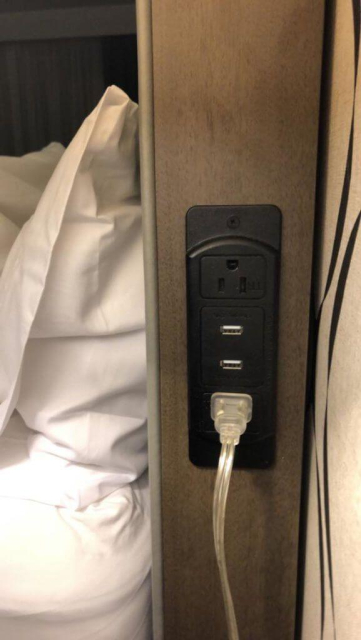
In Berlin this year I stayed at a *new* hotel which only had two spare power points per room. And these were rooms designed for two guests! Two people could easily have six devices to charge between them. Cue me unplugging the TV etc to charge stuff. #travel mastodon.social/@ASegar/115759…
in reply to Tim Richards

1. Premier Inn recently, by the side of the bed was a USB-A port and a USB_C port, but no power.
Since Mac is a strange but wonderful beast, I plugged it's charger into the USB-C port and it pulled only 7 Watts.
So long as I didn't do anything strenuous (and why would I, it was night-time anyway) it didn't discharge, but neither did it charge further.
The power of ARM...

2. On a cruise with my wife and kids recently for a week, the kid's bedroom had 0 sockets in it, no that's not a typo, 0 sockets at all.
We had to request an extension from reception and disconnect the TV in the living room and run the cable under their door.
for us, same situation, but we had 1 socket on my wife's side of the bed but not mine.
In both cases I was sensible and had packed some four-way extension cables so we could at least plug all our gear in, but needed a longer cable from wall to plug...
No idea what fools designed a family cabin without proper sockets but if I ever meet them, I will give them seventeen pieces of my mind...

Andre Louis reshared this.

in reply to Andre Louis

@FreakyFwoof Sadly, this is my experience with a huge number of places. Either 1. there is no socket. 2. There is one socket which is badly placed. 3. There are sockets which are taken up by other things and are difficult to unplug. 4. there are USB sockets which don't work properly. It doesn't matter at all when the place was built, or seems not to. I'm sick of it and to the point of bringing a USB charging station with USB C and a few USB C banks. These can charge laptops/phones, so long as you have a few you can put some to be charged near the single socket using the charging station, and don't need to run cable to anywhere. It's also useful to have them around if you're going to work somewhere, or even if you're a tourist who wants to be out for a long day.

I was today years old when I figured out you can tell your apple device of choice to set a <timer name> for <hours, minutes, seconds> and it'll label that timer with that name and start it. Example, set a pizza timer for 25 minutes. I knew this could be done on the amazon things and maybe google but I didn't know that was a thing on apple stuff.

Juste par curiosité, où vont les méchants pirates francophones pour télécharger illégalement des livres audio en Français, en l’occurence si quelqu’un de peu scrupuleux voulait écouter gratuitement le Silmarillon de Tolkien lu par Thierry Janssen ?

Pas pour moi, je m’apprête à l’acheter pour 21,99€ sans y penser à deux fois, haha. Et ensuite 21,99€ pour La Chute de Gondolin, 21,99€ pour Contes et Légendes inachevés, 18,99€ pour Les enfants de Húrin, et 18,99€ pour Beren et Lutien, car j’adore dépenser mon argent 🙂

This entry was edited (2 hours ago)

I really really wish I could downgrade my rog ally to windows 10 without screwing literally everything up. There is so much happening with resource allocation that I hate and there's not a thing I can do about it. The ally has a layer over the top of windows that gives it functionality like making controler profiles for its built-in controler as well as allowing you to adjust other options, and I know downgrading would unravel everything, but good god there are so many things about 10 that I miss. The biggest one, save the resource use, is the ability to use multiple bluetooth audio devices at once.

Living Conscious Systems

In this brief note I’d like to share two things. Firstly, an event of considerable personal significance: I’ve created my own record label, “Living Conscious Systems”, for experimental organ ambient music, something I’d been thinking about these past few months.

Actually, this is quite a logical development, because I’ve been composing organ music all this time: this week, for instance, saw the release of my album “Wolfen”, a kind of musical portrait of the Wolfen-Nord district where I currently live.

In the foreseeable future I plan to release new works under this label solo, though naturally I hope that in time I’ll find people who share my passion for experimental organ music and will join the label. On that front, I’m fairly optimistic.

coignard.org/lcs

Secondly, I’d like to share how the album “Wolfen” came into being, namely to tell the small stories behind each of the compositions. All of them were created in the first half of December 2025 here, right in the epicentre of Wolfen-Nord.

A bit of context to understand what Wolfen-Nord is and what makes it remarkable: firstly, it’s the place where I currently live, and secondly, a satellite housing estate built for workers in the local chemical industry. At its peak, tens of thousands lived here across multiple residential complexes of panel construction; today the population stands at around 6,000, with most buildings demolished as more and more flats remained empty. The district is inextricably linked to the factory founded here by Agfa in the early twentieth century: it was there they created the world’s first modern colour film, Agfacolor Neu. After the war, when the Americans confiscated the patents and handed them to Kodak, the factory continued working under the brand ORWO (ORiginal WOlfen), one of the most known GDR’s symbols. By the time reunification came, thousands worked at the factory; a few years later, production was closed permanently and everyone went their separate ways.

The first composition I wrote was “Wir aus der Platte”: literally, this translates as “we from the panel block”. There’s a documentary of the same name about this district, and when I finished working on the composition, I realised that yes, to call it anything else would have been criminal. Considering Wolfen’s rich industrial past, right at the beginning it seems to give voice through low-frequency breaths to all the factories situated here, including the very one where they manufactured the “Original Wolfen” film stock.

This town was literally the source of material that captured the heritage of GDR times through thousands upon thousands of cameras in the hands of the republic’s citizens. The people who worked at that factory lived predominantly in these very panel blocks of Wolfen-Nord, in one of which I now live. It’s remarkable how the threads of fate interweave: once upon a time, in my current flat, there lived a factory worker who created this film stock, and now I live here, giving voice to this history. At the very end of this composition, there’s a moment when a recognisable rhythmic pattern emerges and the listener expects continuation, but instead everything slows down like a large, unwieldy mechanism, including that same low-frequency breathing: here I’ve described the fate of my district, which has emptied significantly over the past few decades, with most of the panel buildings demolished.

The second composition became “Stadtwerke”: in German, this translates as municipal utilities. And there’s also an enormous pipe from the local heating plant jutting out of the ground across the entire district, with precisely this inscription written on it. I often wander through the town late at night when I can’t sleep, and in these moments the town appears in quite a different light. It’s empty, mysterious, with this gigantic pipe that’s illuminated by red warning lights at this time of day. You can see it even from the centre of the small town of Jeßnitz, which lies nearby.

During one such walk, when I’d once again wandered deep into Jeßnitz, I saw this pipe and thought: I absolutely must try to give it sound. Upon returning home I immediately set to experimenting: for the tuning I experimented with Pythagorean temperament to achieve the sound I was looking for in a drone context, and just a single stop: Gross Untersatz 32’. A few days later, when the composition was ready, I set off on another walk to listen whether the pipe actually sounded like that. Yes, to my delight, as I wandered through the town listening to this drone produced by the Gross Untersatz 32’, I recognised in it that very Stadtwerke pipe. Well, I’m very pleased: now it has a voice.

Working on the third composition, “Wohnkomplex II”, I wanted to make the organ sound as grounded as possible. I spent a long time searching for the right sound, and eventually decided that one organ alone wouldn’t suffice: I took my old Sony dictaphone and went out to record what was happening outside my flat at that moment. You can hear someone sawing something with an angle grinder, some bird chirping, a dog barking, people chatting at the bus stop. In short, the town is alive. And immediately after the angle grinder, Fagott 16’ sounds on the pedals, sounding terrifyingly recognisable: like the neighbour on the floor below who’s decided to undertake renovations, as if to prove this place still has life in it. A bit later Krumhorn 8’ joins in, and then the background sound of the town disappears, leaving the listener alone with themselves and the sound of these two piercing stops.

Actually, the listener should listen to this composition directly in Wolfen-Nord during a walk, so that in the second part of the composition, when my background noise fades, the noise they encounter around themselves takes its place. Another detail worth mentioning: to name this composition, I had to consult the archive where one could see the original construction plan of Wolfen-Nord and its division into Wohnkomplexes — that’s how I learned that I currently live on the territory of Wohnkomplex II, and since it’s precisely its sounds that are used in this composition, that’s what I called it.

The composition “Willkommen in Wolfen-Nord!” I recorded last of all. The title really begged to be in this album: this inscription is placed on one of the panel blocks at the entrance to the district, and I see it almost every day. Right at the beginning, you can hear the ambience of one of the local shops that’s in close proximity to this inscription, where adverts play and a barely audible whistling sound emanates from the freezer units. It’s smoothly replaced by the now-familiar Gross Untersatz 32’. This is the only stop that sounds in this composition, as in the case of “Stadtwerke”.

At the very end we’re transported to another part of Wolfen, to the railway station in the old part of town. And it seems that in terms of sound and content, it would be logical to conclude the album with this composition, but no: I deliberately use it as the opening theme, and immediately after it comes “Wir aus der Platte”. I did this deliberately because “Willkommen in Wolfen-Nord!” immerses the listener in a sensation of derealisation, of the unreality of what’s happening, and immediately afterwards they wake up in a tower block to the next composition. Time to head off to the factory.

renecoignard.com/living-consci…

#weblog #projects

in reply to André Polykanine

большое спасибо за добрые слова! На самом деле нет, не сложно: да и название уже давно было придумано. Оставалось только зарелизиться (сделано) и опубликовать заметку (тоже сделано). Ну и продолжать пилить гири, собственно (делается) :-)

:boost_requested: Pitching a new federation protocol

Sensitive content

This entry was edited (8 hours ago)

reshared this

Алла Пугачёва выпустила новую песню под названием "Давай просто жить" – предновогодний подарок для поклонников.

В песне звучат строки:
«За место под солнцем опять готовы друг с другом стреляться,
Да где ж оно, счастье, где оно, счастье, где оно, счастье? Не знаю...
Вновь падения и взлеты, боль и успех,
И билет в один конец лишь есть у всех,
По судьбе летим неровно — то вниз, то вверх,
Некуда спешить, некуда спешить —
Ой, давай просто жить!»