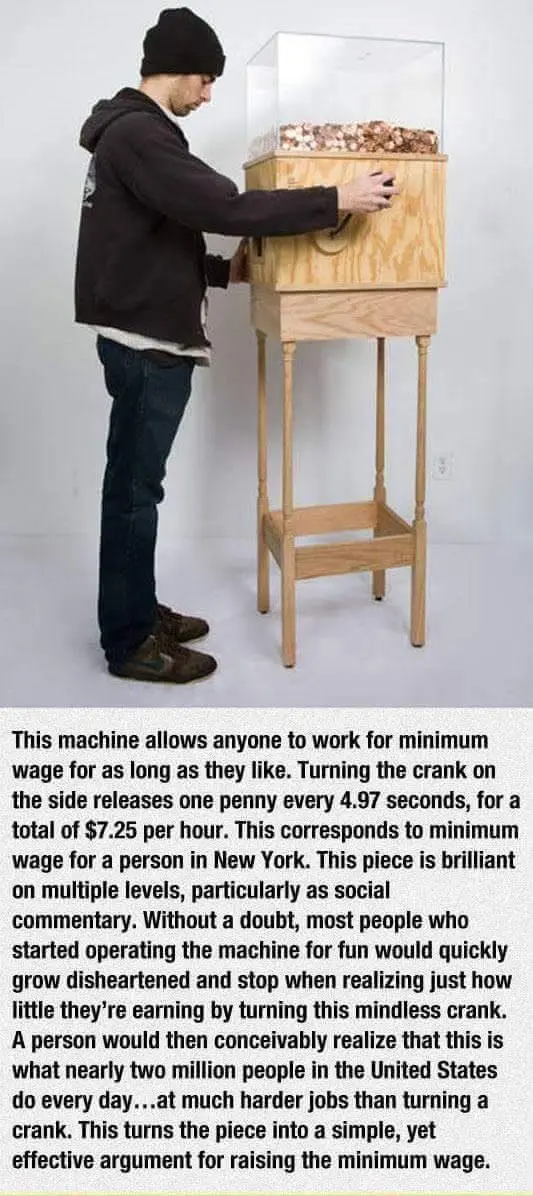
Funnily enough, many people outside NY (and the US in general) would *kill* for such a machine. I have a somewhat-well-paying job in Poland, the pay here is pretty respectable by our standards, and I’m barely making more than this machine would give me, and this is in a somewhat developed EU country.
acoording to numbeo, one would need around 2,983.6$ (14,475.3R$) in Sao Paulo to maintain the same standard of life that one can have with 9,500.0$ in New York, NY. So, it's 218% more expensive there. Meanwhile, our hourly rate is 1.23$ (6R$). So, NY is 218% more expensive, but the minimum wage is 486% greater. @miki has a solid point even lacking data.
@vereda This also depends on what you want to do with your money. Locally-sourced products and services, think food and rent, are usually cheaper in places where salaries are lower, but this is much less true about flights, technology, cars and such. A programmer in Silicon Valley and a programmer in Nairobi might both spend 95% of their respective salaries on food, rent, medical expenses, schooling for their children etc, but the extra 5% in San Francisco will get you a top-of-the-line MacBook and a Tesla, where that same 5% in Nairobi will get you an used Dell laptop from 3 years ago and a mopet. Even better, if you make senior developer money in the US, live like a junior developer or worse and save up the difference, you can then move to a poorer country, perhaps the country you came from, and that difference will get you a long, long way, even though that money wouldn't be enough for three months' rent in California. This difference is much bigger for people who earn a lot, but it is still there, regardless of your level of income.
@miki same here in brazil. People can't pay the rent, but will buy the new phone, even if they have to pay on credit for as long as 18 monthly installments. Once a heard a anthropologist explaining that "because money brings money, owning things that cost a lot signals to others that you are well financially, which increases your chances of making some real money". Crazy.
@miki @vereda actually imho raising minimal wage is temporary, and LEDs to inflation increase, cuz companies increases the prices by raise % with safety factor Way better would be providing maximum wage (progressive taxes?), but it unfortunately seems complicated af to implement Idk how its described in scientific papers, just my thoughts
@bytter @miki @vereda the actual solution has to be to eliminate private ownership of the means of production entirely and replace it with a mix of publicly owned companies and worker owned cooperatives.
@bytter @vereda We also tried this here. My parents’ generation still remember how it was like, and it wasn’t pretty. You can’t enjoy capitalism unless you’ve been on the other side, as it were.
@miki @bytter @vereda I grew up in USSR and I far prefer the communist system. I guess some people only care about themselves and have no qualms with rampant exploitation under capitalism as long as they got theirs.

miki
in reply to Yogthos • • •Yogthos
in reply to miki • • •Nanda Queiroz
in reply to Yogthos • • •miki
in reply to Nanda Queiroz • • •Yogthos
in reply to miki • • •@miki @vereda this doesn't apply to people on minimum wage however, because they often can't even afford basic necessities in US.
40% of the population can't afford a $400 unexpected expense. Meanwhile, 37% of the population now works two full time jobs.
The reality of the situation is that minimum wage isn't even livable in US.
fortune.com/2023/05/23/inflati…
denver7.com/news/national/more…
More Americans report being 'over-employed' by working 2 full-time jobs
Scripps News Staff (Denver 7 Colorado News (KMGH))miki
in reply to Yogthos • • •Yogthos
in reply to miki • • •Nanda Queiroz
in reply to miki • • •toxidrone
in reply to Nanda Queiroz • • •miki
in reply to toxidrone • • •Hakki(bytter was too imperial)
in reply to Yogthos • • •Way better would be providing maximum wage (progressive taxes?), but it unfortunately seems complicated af to implement
Idk how its described in scientific papers, just my thoughts
Yogthos
in reply to Hakki(bytter was too imperial) • • •miki
in reply to Yogthos • • •Yogthos
in reply to miki • • •OpenDNA⚙️
in reply to miki • • •@miki Yeah but Poland has a home ownership rate roughly 50% higher than the US. The median wage in Poland won't cover rent in New York.
The US would have to hand out nearly 100 million homes to begin to make wage comparisons meaningful.