Friendica
Ada Palmer
Ada Palmer

Ada Palmer

adapalmer@wandering.shop

Ada Palmer

adapalmer@wandering.shop
F&SF Novelist (Terra Ignota), historian (U Chicago), Renaissance, book history, censorship, classics, disability activism, FILK music Sassafrass, manga/anime Tezuka, chronic pain
ActivityPub
2025-01-14 22:41:16 2025-01-14 22:41:10 2025-01-14 22:00:16 6577003

Ada Palmer
Ada Palmer
mastodon - Link to source

Ada Palmer

11 months ago • •

Ada Palmer

11 months ago • •


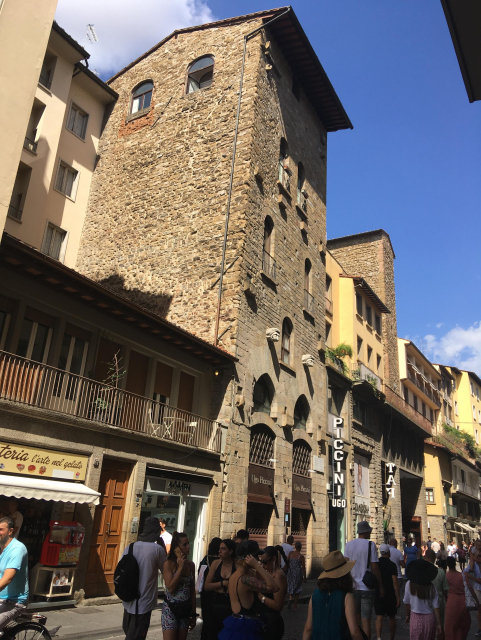
Day 2 sharing teaser #HistoryPix for "Inventing the Renaissance" (out in one month!). Often in Florence one sees buildings like this, where one section is rough stone standing out amid stucco neighbors. It's actually a remnant of the old Guelph-Ghibelline feuds that so long rocked Medieval Italy 1/?
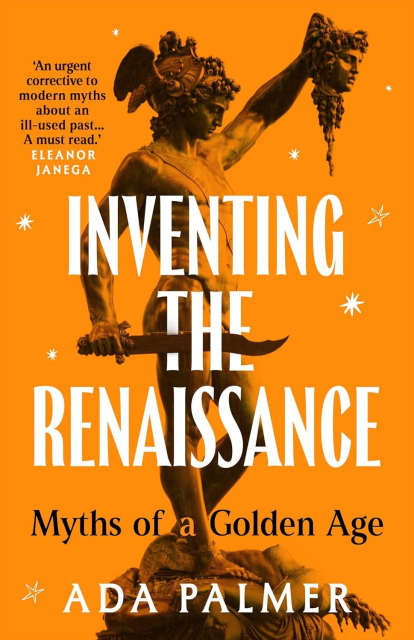
An orange book cover showing Cellini's statue of Perseus holding aloft the severed head of Medusa, her neck streaming gore. The title "Inventing the Renaissance: Myths of a Golden Age" is superimposed over the statue, with the word "the" pierced by the sword. The author's name "Ada Palmer" appears below.
A photo of a street in Florence. Many tourists walk along and the buildings are all shops and eateries. In the center, conspicuous between buildings of yellow or beige stucco, is one building made of crude-looking yellowish stone, very rough and undecorated, with few windows and all small compared to its neighbors. A couple doors down, a second conspicuous stone section like this sticks up, also strangely blank and rough amid its yellow neighbors. Both stop about half a story above the roofs of the three-story buildings on either side of them.
#historypix
  •  Languages
  •  Search Text
  •  Share via ...
in reply to Ada Palmer

Ada Palmer
mastodon - Link to source

Ada Palmer

in reply to Ada Palmer • 11 months ago • •
These are actually the bottom nubs of Medieval stone towers. The town of San Gimigniano is famous for having several still intact. Wealthy families built these as mini-fortresses within the city, where they could defend against riots, enemy families (think Montagues and Capulets) and invasion 2/?
A classic image of the skyline of the town of San Gimigniano, with many smaller houses three or four stories tall with the characteristic Italian yellow stucco walls and terra cotta tiled roofs, but with eleven stone towers sticking up far above them, towering twelve stories or more. The towers are very plain and blank, just squares of stone without decoration and with few windows, clearly utilitarian more than aesthetic.
  •  Languages
  •  Search Text
  •  Share via ...
in reply to Ada Palmer

Ada Palmer
mastodon - Link to source

Ada Palmer

in reply to Ada Palmer • 11 months ago • •
Signs of wealth and prestige, these all-stone buildings were also fireproof, leading to a terrible but effective tactic: take your family, treasures & goods up into your tower then set fire to enemies' homes and let the city burn around you while you sit safe above. This was VERY BAD for cities 3/?
Photo of a street corner in San Gimigniano, with several plain-sided square stone towers sticking up above the roofline against a bright blue sky.
  •  Languages
  •  Search Text
  •  Share via ...
in reply to Ada Palmer

Ada Palmer
mastodon - Link to source

Ada Palmer

in reply to Ada Palmer • 11 months ago • •
After many disasters, Florence's solution was to BAN private buildings over a certain height, forcing everyone who had a tower to knock the top off down to regulation height, leaving these recognizable stone nubs all around the city. This round one is the oldest (now a restaurant). 4/?
Photograph of some buildings crammed very close together. Those on the left and right are yellow stucco with large windows. In the middle, touching both of them, is a circular section made of rough nubbly stone, that really looks like it could be the bottom part of a round castle tower, it just needs battlements or a pointy cone roof. Instead it's lopped off flat just above the roofs of the other buildings.
  •  Languages
  •  Search Text
  •  Share via ...
in reply to Ada Palmer

Ada Palmer
mastodon - Link to source

Ada Palmer

in reply to Ada Palmer • 11 months ago • •
My favorite tower stub is this one, in Via dei Cerchi. I lived on the top floor for a year as a grad student, up 111 steps! I had calves of steel by spring, but the views from the top looked like someone had put a poster of Florence on the wall except it was a window! 5/?
Photo of a street of town buildings, all squeezed together sharing walls with no gaps between. The one on the left is yellow stucco, with an archway and a "Coin" grocery store. The one on the right is yellow stucco above with decorative faux rustic stone facing on the lower floor. In between them, about the width of one storefront, is a section where the wall is rough rubbley stone, with one small and one large arched door at the bottom, and very small windows above. The large arched door would have had a fortress gate large enough for horses to enter, but is now a tabacchi shop.
Photograph through a semicircular window, showing a roofline and the tower of Florence's famous Palazzo Vecchio sticking up above. This window was in the bathroom! I had this view from the toilet! It was incredible!
  •  Languages
  •  Search Text
  •  Share via ...
in reply to Ada Palmer

Ada Palmer
mastodon - Link to source

Ada Palmer

in reply to Ada Palmer • 11 months ago • •
Only city buildings were allowed to exceed the mandated height, which is why Florence's skyline is now all special buildings: monastery bell towers, the cathedral & baptistery, Orsanmichele the city's granary (tall to keep grain away from water & mice), the seat of government, and one special guy 6/?
Photograph of the Florence skyline from the south side of the river. Sticking up above the sea of fairly flat tiled roofs one can see a few distinctive buildings. To the left is the battlemented Palazzo Vecchio with its tall square battlemented tower. To the right and behind it (hard to see) is the city granary. Toward the center is the red dome of San Lorenzo, and in front of it the white hexagonal pointy roof of the Baptistery. Just to the right of the baptistery is the enormous cathedral with its stripey bell tower and massive dome. In front of the cathedral are two towers, one pointy, and one square; the square one is circled in yellow and we'll zoom in on it in a moment.
  •  Languages
  •  Search Text
  •  Share via ...
in reply to Ada Palmer

Ada Palmer
mastodon - Link to source

Ada Palmer

in reply to Ada Palmer • 11 months ago • •
The tower on the right here is part of Bargello, the prison & police fortress, but it didn't start that way. It was built by a private family, who sold it to the city when the law banning towers was passed, and the city incorporated it into their prison fort. 7/?
A photograph taken from my tower apartment across the roofs of Florence. Two golden stone towers stick up above all the red tiled roofs. On the left is a pointy one with crosses on it, part of the Badia monastery. On the right is a square one with battlements and big open windows, connected to a fortress with more battlements.
  •  Languages
  •  Search Text
  •  Share via ...
in reply to Ada Palmer

Ada Palmer
mastodon - Link to source

Ada Palmer

in reply to Ada Palmer • 11 months ago • •
The city jail had to be a fortress in case someone from a powerful family was arrested and the family sent goons to break them out (those guys who bite their thumbs in the opening scene of Romeo & Juliet would *totally* have stormed the jail to bust Romeo out!). 8/?
Photo of the inside of the Bargello fortress, with strong pillars and high arches. On the pillars are iron rings for tying up horses, and on the walls are the coats of arms of many nobles who served as the city's chief of police (the Podesta). The fortress also has its own well, in case of siege!
  •  Languages
  •  Search Text
  •  Share via ...
in reply to Ada Palmer

Ada Palmer
mastodon - Link to source

Ada Palmer

in reply to Ada Palmer • 11 months ago • •
In this photo you can see how the brick battlements are a later addition, added to the tower as part of its transformation from private fortress to public. 9/?
In the foreground is a stone wall with battlements. Sticking up behind it, against a bright blue sky, is the top of a stone tower. The tower itself is the same yellowish stone as the wall, but on top of the tower is a balcony area with battlements clearly added in red brick, and lined on top with metal sheeting to protect against the weather. The golden weathercock on top is on edge at the moment, and barely visible.
  •  Languages
  •  Search Text
  •  Share via ...
in reply to Ada Palmer

Ada Palmer
mastodon - Link to source

Ada Palmer

in reply to Ada Palmer • 11 months ago • •
What did Florence look like back when it had all its towers? Its long-time ally across the mountains Bologna is famous for still having two intact towers, but in the Middle Ages Bologna was known as the City of 100 Towers because so many families built them. The reconstructions look... 10/?
Photo of the famous square in the center of Bologna where two square stone towers on opposite sides of a street stick way, way, way, way up above the other buildings. Their bare stone sides are pierced only by a few very small windows, and undecorated. They are wrapped in modern metal bracing to help protect them from crumbling.
  •  Languages
  •  Search Text
  •  Share via ...
in reply to Ada Palmer

Ada Palmer
mastodon - Link to source

Ada Palmer

in reply to Ada Palmer • 11 months ago • •
...absolutely incredible. Here's what Medieval Bologna would have looked like when all its towers were intact. Florence didn't have so many but did have dozens, so the richest part of the city center would have looked much like this. Much to the despair of the city fire brigade! 11/?
Photo of a model of Bologna, with so many earthy pink tall skinny towers sticking up from every block of the terra-cotta-roofed town that it looks like plant seeds starting to come up in spring. Around the edge you can see the city's moat and battlemented walls, looking tiny compared to the towers which rise to six or seven times the height of the three-story buildings around them.
  •  Languages
  •  Search Text
  •  Share via ...
⇧