
WHERE IS YOUR GOD NOW??? That rascal’s always wandering off

An important PSA for people who are active on #Bluesky and who, upon hearing that the ICE account was officially verified, are saying: "I will just block it."
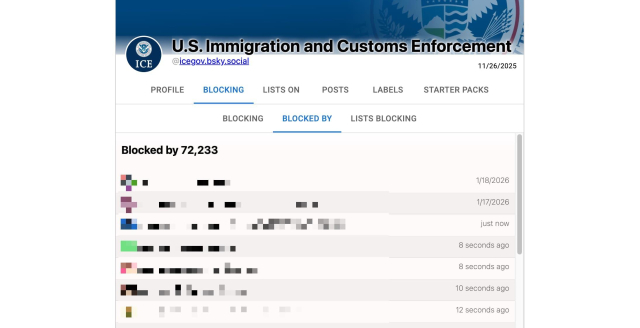
Blocking on Bluesky is NOT PRIVATE: it's very easy to see who is blocking any account by visiting sites that list that information.
I took a screenshot from clearsky.app, listing all the accounts that are blocking ICE (I pixelated avatars and usernames for privacy purposes).
The safest bet is to mute (that info is private) 😫
This is also true about Mastodon*, but Mastodon actively tries to hide that fact from users and muddy the waters.
* It's technically hidden to users but not the admins of the instances involved, but if you're a gov agency, you're presumably on your own instance, as seems to be the custom here for the "big players."
miki reshared this.
In a way, #Putin even got more then he ever could wish for
All for free by #Trump
Alliances shattered, internal threats, everyone really disliking the US, speaking about war within #NATO even
It's unbelievable how much damage that senile dic(tator) has done within a year
I really hope we learn from this.. But history shown otherwise I guess
This post by Bruce Schneier contains so many thoughtful soundbites:
> The question is not simply whether copyright law applies to AI. It is why the law appears to operate so differently depending on who is doing the extracting and for what purpose.
> Like the early internet, AI is often described as a democratizing force. But also like the internet, AI’s current trajectory suggests something closer to consolidation.
schneier.com/blog/archives/202…
More than a decade after Aaron Swartz’s death, the United States is still living inside the contradiction that destroyed him. Swartz believed that knowledge, especially publicly funded knowledge, should be freely accessible.Bruce Schneier (Schneier on Security)
I like looking at this through the concept of "enjoyment", which was originally developed in Japan I believe.
From that point of view, copyright only applies to a work when it is used for "enjoyment", for its intended purpose. If the work is primarily entertainment, it applies when the consumer is using it to entertain themselves. If the work is educative, it applies when the consumer is using it to learn something. It does not apply when the work is used for a purpose completely unrelated to its creation, such as testing a CD player on an unusual CD, demonstrating the performance of a speaker system, training a language model to classify customer complaints etc.
(This isn't a legal perspective, not even quite in Japan I believe, but it's useful lens through which we can look at the world and which people can use to decide on policy).







As curl now supports TLS (mqtts), it is no longer necessary to list it as a limitation in the docs.GitHub
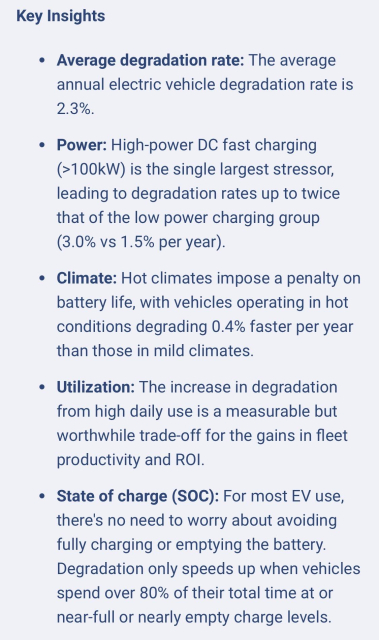
TL;DR Most EV batteries will last longer than the cars they’re in. Battery degradation is at better (meaning: lower) rates than expected. Slow charging is better. Drive EV and don’t worry about your battery.
„Our 2025 analysis of over 22,700 electric vehicles, covering 21 different vehicle models, confirms that overall, modern EV batteries are robust and built to last beyond a typical vehicle’s service life.“
geotab.com/blog/ev-battery-hea…
PQ leader says Legault's resignation further evidence of need for independent Quebec
cbc.ca/news/canada/montreal/qu…
tl;dr: the leader of the PQ is full MAGA. He believe in Santa Claus. He believe that in the US dictatorship Quebec and it's francofascism would be safe. Remember MAGA implies hating anyone speaking something other than English.
RE: mstdn.social/@TechCrunch/11591…
oh look, another AI chat tool pops on the block.

Attached: 1 image Confer is designed to look and feel like ChatGPT or Claude, but your conversations can't be used for training or advertising. https://techcrunch.TechCrunch (Mastodon 🐘)
Why Poilievre and Carney Are Silent on Grok’s Child Sexual Abuse
thetyee.ca/Opinion/2026/01/15/…
The former is just in his cesspool, running is con. The latter is just an hypocrite coward elite that would have no problem with Internet legislation when they can't enforce the basics.

The Liberals are afraid of Trump. The Conservatives fear their base.Eric Van Rythoven (The Tyee)
Sensitive content
Scott
in reply to Sy Hoekstra • • •Sy Hoekstra
in reply to Scott • • •