
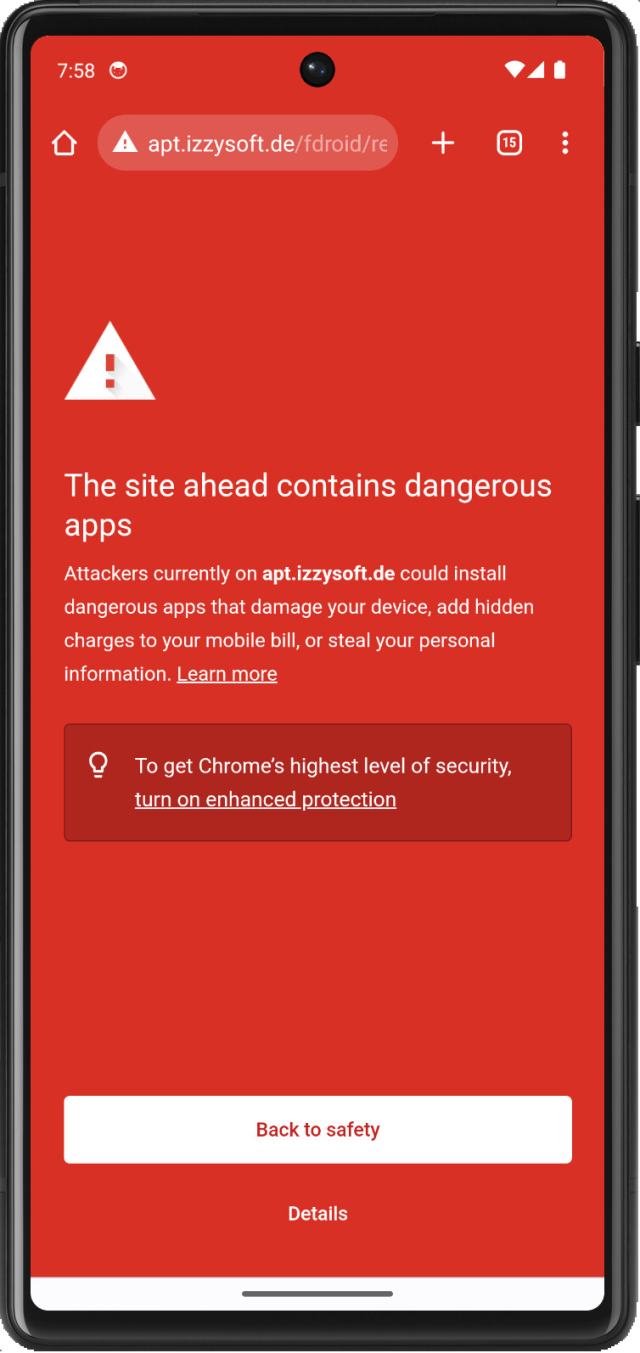
We are receiving reports that Google flags our repo as "having dangerous apps" or being a "dangerous site" – texts being very vague, no proof given (nor did they inform us). They also link to a page they call "Transparency Report" – which is of the same vagueness, but definitely not transparent (transparencyreport.google.com/…)
We're not aware of any such dangerous content. All apps on our repo are properly scanned, see izzyondroid.org/about/security…

Cat 🐈🥗 (D.Burch)
in reply to IzzyOnDroid ✅ • • •IzzyOnDroid ✅
in reply to Cat 🐈🥗 (D.Burch) • • •@catsalad Maybe they want to create facts to show why they need to protect us all?
I mean, there's a slight difference between "protect" and "play protect" 🙊 💨
IzzyOnDroid ✅
in reply to IzzyOnDroid ✅ • • •Google did not inform us. Especially did they not inform us WHICH pages/apps at IzzyOnDroid they consider "dangerous", or WHY. Nor did they give us any means to respond to that threat. It is sad that they are obviously unable to do so. It seems to be asking too much, expecting at least a mail to "webmaster@"…
Should you have any deeper insights, please let us know.
Nazo
in reply to IzzyOnDroid ✅ • • •Taking bets right now that it's because your repo is "dangerous" because it's not their "controlled" one.
They seem to be desperately wanting to pull an Apple right now and stuff like alternatives existing makes that really hard.
IzzyOnDroid ✅
in reply to IzzyOnDroid ✅ • • •Out of curiosity, I've asked VirusTotal for its opinion. All 97 engines report "green". Fun fact: that includes "Google Safebrowsing". If you want to check for yourselves, here's a fresh report generated less than 5 minutes ago:
virustotal.com/gui/url/fbab133…
VirusTotal
www.virustotal.comiguana09863
in reply to IzzyOnDroid ✅ • • •IzzyOnDroid ✅
in reply to iguana09863 • • •@iguana09863 thanks, but there is no "relations" tab. And all our APKs are run through VirusTotal as well. Would one have been tampered with on-site, it would be overwritten on the next sync again.
And APKs do not get infected by copying them. If those malicious people copy them for such purpose, they usually modify them, too. Which would not only break the signature, but also lead to a different file hash. It's all FOSS, they could compile such APKs themselves.
iguana09863
in reply to IzzyOnDroid ✅ • • •internxt.com/virus-scanner
Internxt – Free Online File Virus Scanner
InternxtIzzyOnDroid ✅
in reply to iguana09863 • • •🎆🎉 Masto New Year 🎊🎇
in reply to IzzyOnDroid ✅ • • •#FuckGoogle #DeGoogle
Google peddling lies just shows how far they've fallen.
Sebastian Lasse
in reply to IzzyOnDroid ✅ • • •keep in mind that dangerous content can have a broad meaning in fascism.
Maybe you wrote "fediverse", "EU", "Breton", "HateAid", "CCDH" or "Antifa" ?
Then you are a dangerous witch !
Koen 🇺🇦
in reply to IzzyOnDroid ✅ • • •liberloebi 📖
in reply to IzzyOnDroid ✅ • • •gkrnours
in reply to IzzyOnDroid ✅ • • •edge browser had a blog post explaining they had better performance than chrome, mosyly measured in battery drain on laptop, but youtube kept changing small thing that was invisible to most user but broke hardware playback on edge browser and software video playback consumed twice as much battery. After a time, they gave up, switched to using chrome rendering engine instead of their own issue stopped.
these scary message remind me of that
IzzyOnDroid ✅
in reply to IzzyOnDroid ✅ • • •We've registered our site with the Google Console now to get details on the pretended infection. The screenshot below are what they call "full details" – a joke. Nothing applicable (apologies for the German screenshot, but I couldn't see a way to switch the language).
So we requested a re-check. They wanted to know how we solved the problems. All we could tell them is that we checked all details they had provided…
Sylvia
in reply to IzzyOnDroid ✅ • • •I've been keeping an eye on this. Google says the re-review didn't pass, again giving no URLs, but also states that all is safe now. Which makes no sense but also is par for the course for Google's general extremely incompetent reviewing.
All I can say is... Google Search Console is green so... fixed? Ridiculous that they can block websites from being reachable by so many people but can't even clearly communicate what they claim they found. With great power comes no responsibility?
IzzyOnDroid ✅ reshared this.
IzzyOnDroid ✅
in reply to Sylvia • • •Thanks @SylvieLorxu ! So again they claim there are harmful pages, but cannot point out a single one. Instead, the summary reads "no issues detected". So they do not even know themselves, huh? Well, "all green", so let's hope this episode is over now.
But put them in charge of security for the entire internet, what could go wrong… 🤦♂️
Leeloo
in reply to IzzyOnDroid ✅ • • •IzzyOnDroid ✅
in reply to Leeloo • • •Cassandrich
in reply to IzzyOnDroid ✅ • • •IzzyOnDroid ✅
in reply to Cassandrich • • •Cassandrich
in reply to IzzyOnDroid ✅ • • •IzzyOnDroid ✅
in reply to Cassandrich • • •@dalias Not sure it works that way here in Europe. But if there's a lawyer around who wants to pick this up that way, they're welcome.
We'd also welcome a fix and public apology from Google here, in a way making that lawyer "unneeded". Giving the missing details would be a start, I'd say. We're not exactly "bored" here, that we'd need a fight to have something to do…
IzzyOnDroid ✅
in reply to Cassandrich • • •@dalias I mean, imagine a big news portal claiming Google Play had been hacked, and "attackers currently on that site" would install dangerous apps, etc. pp. The fact alone to claim there are "attackers on the site"!
To me, this looks like scare mongering. I didn't expect they'd consider us such a dangerous competition, to need such actions…
Pavle
in reply to IzzyOnDroid ✅ • • •We've been getting similar reports on some sites we're building at my workplace (totally unrelated to Google's stuff), even some internal test/dev instances not accessible from outside the company...
Just mentioning because it might not be entirely targeted/malicious, seems like they've been ramping up this "safe search" algorithm and might have just made it a bit too agressive. Still sucks not having a proper reason for why though.
silkysoft fluffything 🍮 [Viridi Vix]
in reply to IzzyOnDroid ✅ • • •Dam H.
in reply to IzzyOnDroid ✅ • • •ClemensG
in reply to IzzyOnDroid ✅ • • •🇩🇪 Nur kurz vom Spielfeldrand: Es gibt Menschen wie mich, die dir mehr trauen als Google. Danke für deine hilfreiche und kontinuierliche Arbeit. Und lass dich nicht ärgern.
🇬🇧 Just a quick note from the sidelines: there are people like me who trust you more than Google. Thank you for your helpful and continuous work. And don't let it bother you.
Ԏєηυкι, 手抜き🚀🐧♏ 🔭 ⚫⚪
in reply to IzzyOnDroid ✅ • • •