
Sensitive content
I heard about inaccessibility of #DreamHost, a hosting platform preferred by many blind users for some reason.
If you want to migrate, don't know where and you want great support, free websites migration and #CPanel, there's #A2Hosting. I've been with them for twelve, nearly thirteen years now, and they still have great and extremely helpful support, a plethora of #PHP versions from 4.4 to the most recent 8.3, one-click installer for many popular software like #WordPress, an optimization plugin for WP of their own, support for more technologies like #Python, #Ruby, #NodeJS, different solutions for your needs starting from the very basic shared hosting to the most requiring dedicated servers.
I'm not affiliated with the company, they don't pay me a cent, but if you find my suggestion useful, you can use my referral link while signing up:
a2hosting.com/refer/38061.
If you don't want to do that, no pressure, just go to a2hosting.com/ and find out on your own.
Oh, and they have email, PHPMyAdmin for your lovely Maria (or PhpPgAdmin if you prefer PostGres), SSH access and many more!
If you want to migrate, don't know where and you want great support, free websites migration and #CPanel, there's #A2Hosting. I've been with them for twelve, nearly thirteen years now, and they still have great and extremely helpful support, a plethora of #PHP versions from 4.4 to the most recent 8.3, one-click installer for many popular software like #WordPress, an optimization plugin for WP of their own, support for more technologies like #Python, #Ruby, #NodeJS, different solutions for your needs starting from the very basic shared hosting to the most requiring dedicated servers.
I'm not affiliated with the company, they don't pay me a cent, but if you find my suggestion useful, you can use my referral link while signing up:
a2hosting.com/refer/38061.
If you don't want to do that, no pressure, just go to a2hosting.com/ and find out on your own.
Oh, and they have email, PHPMyAdmin for your lovely Maria (or PhpPgAdmin if you prefer PostGres), SSH access and many more!
The Best Web Hosting Services at 20x Speeds - A2 Hosting
If you are looking for fast and reliable web hosting, A2 Hosting is the company for you. We provide up to 20x the speed of competitors with a 99.9% uptime!Ercument Sahin (A2 Hosting)












![Photo of a cat sniffing the camera with a Windows message prompt that says:
System message ⛝
you have been sniffed
[Ok] [Cancel]](https://fedi.ml/photo/preview/640/607648 "Photo of a cat sniffing the camera with a Windows message prompt that says:
System message ⛝
you have been sniffed
[Ok] [Cancel]")























John Carlos Baez
in reply to John Carlos Baez • • •Okay, I hung up the laundry. Imagine an enormous star flinging off its outer layers after it runs out of fuel and its core collapses under its own gravity. If it doesn't become a black hole, the core can shrink down to a ball of neutronium just 20 kilometers across. Just as a ballerina spins faster as she pulls in her arms, this ball spins really fast - like 1000 rotations a second. And since neutronium conducts electricity, it can blast out radio waves as it spins, creating a blinking radio signal, called a pulsar. Pulsars are so precisely periodic that when Jocelyn Bell first spotted one, people thought it was a signal from aliens!
Like the rest of us, pulsars slow down as they age. But this also means their signal weakens. So we usually don't see pulsars in the gray region of this chart - to the right of the line called the 'pulsar death line'. Pulsars are the gray dots to the left of this line. The pink squares are called 'magnetars'. These are the squalling infants in the world of pulsars: young and highly magnetized neutron stars that do crazy stuff like put out big bursts of X-rays now and then.
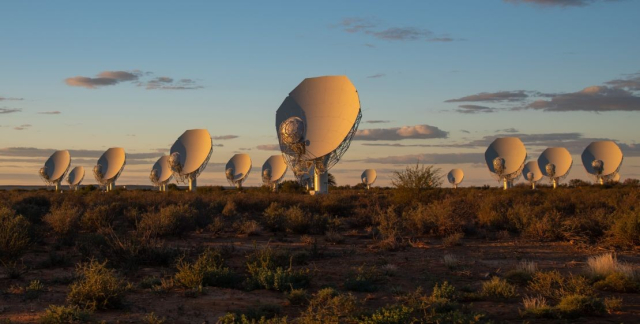
But then there are weirder things. A telescope array called the Australian Square Kilometer Array Pathfinder was searching for radio waves connected to a gamma ray burst in 2022 when it stumbled on something that blasts out radio waves about once an hour. It lost track of this object, so folks brought in the more powerful MeerKAT radio telescope and found it again.
Now it's called ASKAP J1935+2148. It's well to the right of the pulsar death line. What could it be?
(2/3)
John Carlos Baez
in reply to John Carlos Baez • • •The radio source ASKAP J1935+2148 is an amazing thing. It blasts out radio waves once every 54 minutes, which is incredibly slow for a pulsar. Pulsars usually pulse somewhere between 1000 times a second and once every few seconds.
ASKAP J1935+2148 puts out 3 kinds of pulses in a rather random way: bright pulses, weak pulses, and no pulse at all. But if you fill in the missing pulses, you'll see the pulses keep the same period with an accuracy of 1/10 of a second. So I imagine it must be something quite heavy slowly spinning around, which has a patch that switches between 3 modes of radio emission.
It could be a really weird pulsar, but nobody knows how a pulsar spinning so slowly could put out radio waves. Another candidate I've read about is a 'magnetic white dwarf'. These are white dwarf stars that have strong magnetic fields. Nobody knows why! But also, nobody has seen one put out radio pulses. So this also seems like a long shot.
In short, it's a mystery! And that means we'll learn something cool.
For a nice account of this, try Astrobites:
• Magnus L'Argent, This ultra-long period radio signal can’t make up its mind, astrobites.org/2024/07/02/ultr…
For even more details, try this:
• M. Caleb et al, An emission-state-switching radio transient with a 54-minute period, nature.com/articles/s41550-024…
The animated gif here shows an artist's impression of an ordinary pulsar, not ASKAP J1935+2148. It's probably been slowed down a lot.
(3/3)
This ultra-long period radio signal can’t make up its mind
astrobites