
Jinak #wick těch 9 km měl fakt na pohodu 😄👍
Kaum zu Glauben #AppOnly-Modell jetzt auch für Kaffee & Kuchen.
(Gesichtet in Berlin Wedding)
#digitalOnly #teilhabe #Digitalzwang #wedding #AllVegan!!!

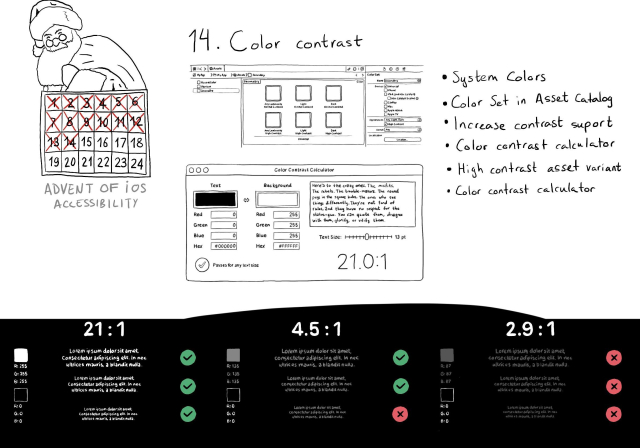
Day 14 - #adventOfIOSAccessibility. iOS and Xcode provide a wide variety of tools and options to deal with color, and help us providing good color contrast ratios. From system colors that automatically support Increase Contrast, to high contrast (and light and dark mode) color asset variants, automatic checks with the Audit feature in the Accessibility Inspector, and even a built-in contrast calculator.

Ogni volta che passo davanti a questa pizzeria ad Abano Terme (PD) sono leggermente triggerato dal nome e dal logo 🐧
Ma le ricette saranno open source?

Steffo (moving) likes this.
𝔻𝕚𝕖𝕘𝕠 🦝🧑🏻💻🍕 likes this.
Remember: IDN is crazy. And just not just a little.
daniel.haxx.se/blog/2022/12/14…

IDN, International Domain Names, is the concept that lets us register and use international characters in domain names, and by international we of course mean characters outside of the ASCII range.daniel.haxx.se
For once, you write wrong things. Just one: the "crazy" example you show is disallowed since IDN does not allow many of these characters: afnic.fr/en/observatory-and-re…
You may sometimes see emojis – those little pictograms used in e-communication – in domain names.Stéphane Bortzmeyer (AFNIC)

Hello Windows Insiders, Today we are beginning to gradually roll out the ability to seamlessly share files between your iPhone® and Windows 11 or Windows 10 PC when they are connected via Phone Link and the Link to Windows app. To use this featureWindows Insider Blog

OpenAI is rolling out a feature called “Projects” to ChatGPT that gives you folders to organize things you’re working on while using the AI chatbot.Jay Peters (The Verge)



The four most popular ways to use RDF-based metadata on websites are RDFa-Core, RDFa-Lite, Microdata, and inline JSON-LD.
I can’t use RDFa-Lite because I need rel HTML attributes. rel silently upgrades RDFa-Lite to RDFa-Core, which parses differently. I doubt all parsers upgrade correctly; some will try to parse RDFa-Core as RDFa-Lite. Conformant RDFa parsers upgrade RDFa-Lite pages to RDFa-Core despite many authors only being familiar with RDFa-Lite. I suppose resources like Schema.org and Google’s documentation only documenting RDFa-Lite markup worsens the confusion. Update 2024-12-16: Sarven Capadisli has clarified on the Fediverse that this is the behavior of one faulty parser; rel only triggers an upgrade when used with an RDFa namespace. I may re-evaluate RDFa.
With RDFa split between two incompatible alternatives with a confusing upgrade mechanism, the alternatives are Microdata and JSON-LD. I use structured data extensively; JSON-LD would duplicate most of the page. Let’s use this relatively short article as an example. Exruct can convert the embedded Microdata into a massive JSON document featuring JSON-LD. Take a look at the JSON-LD and HTML side by side. Microdata attributes take a fraction of the footprint, encode the same information, and don’t require duplicating nearly the entire page.
Originally posted on seirdy.one: See Original (POSSE). #Microdata #SemanticWeb #RDFa #HTML

Extract embedded metadata from HTML markup. Contribute to scrapinghub/extruct development by creating an account on GitHub.GitHub
Seirdy reshared this.
My approach:
* all human-readable information is visible and actionable in markup languages (HTML, SVG, MathML..)
* anything significant has a URI and machine-readable.
For my purposes, publishing various types of content and working on an application ( dokie.li/ ) - it comes down to using the full expressivity of #RDFa.
Why RDFa: csarven.ca/linked-research-dec…
Hope I understood you correctly; not trying to change your mind:
Unless you've already checked w/ other #RDFa parsers, I wouldn't rely on GRRT (referenced blog post). AFAICT, GRRT wasn't parsing the HTML snippet correctly back then nor now for that HTML snippet.
If you don't use the `vocab` attribute, values like `license` are ignored by the RDFa parser (unless host language's default vocab is applied). For anything else parsing plain ol' rel=license, that's not an issue anyway.
Seirdy likes this.
rel only triggers an upgrade when used with an RDFa namespace. I may re-evaluate RDFa.I am Sarven Capadisli and this Web site contains a collection of my thoughts and interests.csarven.ca
Seirdy reshared this.
We're very disappointed Let's Encrypt is ending support for proper revocation checks via OCSP Must-Staple which is the only efficient, private and secure method not depending on a browser-specific service:
letsencrypt.org/2024/12/05/end…
No replacement is being offered for the feature.

Earlier this year we announced our intent to provide certificate revocation information exclusively via Certificate Revocation Lists (CRLs), ending support for providing certificate revocation information via the Online Certificate Status Protocol (O…letsencrypt.org
I wrote about this in detail here after the statement of intent: seirdy.one/posts/2024/09/25/po…
I think the ideal solution would be replacing live lookups with CRL shards, and preserving must-staple until either OS-level CRLite- or Let’s Revoke- like filters roll out or until short-lived certs become available.
But I understand the decision. A fraction of a percent of websites have must-staple, an even smaller fraction use a good implementation like ocsp-fetcher or caddy, and a small fraction of traffic is from a browser that does OCSP stapling properly. The massive amount of engineering effort for the tiny gain isn’t something they can justify.
I’m disappointed that they probably won’t go with ACME-STAR, which is the most robust option I looked at in that post (especially when combined with delegated credentials).

OCSP, including OCSP Stapling, is leaving the Web PKI. Here's a complete look at revocation beyond OCSP: its past, present, and possible futures.Seirdy’s Home
Check out this great listen on Audible.com. From the Booker Prize finalist, author of The Island of Missing Trees, an enchanting new tale about three characters living along two great rivers, all connected by a single drop of water.Audible

Here at Time Magazine, We’ve Decided This Is Another One of Those Years We Pick a Person Who Fucking Sucks
mcsweeneys.net/articles/here-a…

Every year, we pick someone to be our Person of the Year, and we put their face on the cover of our magazine. It’s, like, the big thing you know ab...McSweeney's Internet Tendency



reshared this

#Outreachy internship for librsvg, December 2024 - viruta.org/librsvg-outreachy-d…
Internado de Outreachy para librsvg, diciembre 2024 - viruta.org/librsvg-outreachy-d…
One of the major scientific achievements of the 19th century was milk that didn’t kill babies.
People seem to have forgotten the importance of that.

Jeseň ubehla rýchlejšie než som plánoval, ale to nie je to podstatné, čo som chcel povedať. Dosť som totiž uvažoval, ako poňať pokračovanie môjho predchádzajúceho blogu, a teda ako by mala vyzerať lekcia 2.
Nakoniec som sa rozhodol nenosiť drevo do lesa a prichádzam iba s prekladom článku z eff.org - How to: Understand and Circumvent Network Censorship licencovaného pod otvorenou licenciou CC-BY takže to čo teraz budete čítať, nie je moje dielo, iba môj pokus o preklad.
herrman.sk/home/ako-sa-priprav…
#eff #cenzura #blog #vladamrzkejluzy #dns #vpn #proxy #tor
Informačná bezpečnosť sa týka každého!www.herrman.sk
reshared this
Don’t tell my wife but I made her a gift with my own little hands. And some tools.
Be nice, it’s only my second try.



Discover more about what's new at AWS with Amazon EC2 instances support bandwidth configurations for VPC and EBSAmazon Web Services, Inc.

Sesame Street’s new episodes currently air first on Max, but that deal with Warner Bros Discovery will expire soon.Umar Shakir (The Verge)
reshared this

My partner and I first broached the possibility that we might need to flee the country last summer. After election day, we began that preparation in earnest. I’m making the document we used t…Haste Makes Waste
"Ein juristisches Gutachten klärt, in welchen Fällen digitale Dienstleistungen auch analog angeboten werden müssen. Es kommt zu dem Schluss, dass ein Verbot von #Digitalzwang ins #Grundgesetz gehört."
netzpolitik.org/2024/digitalzw…

Ein juristisches Gutachten klärt, in welchen Fällen digitale Dienstleistungen auch analog angeboten werden müssen. Es kommt zu dem Schluss, dass ein Verbot von Digitalzwang ins Grundgesetz gehört.netzpolitik.org
The FBI encouraging citizens to use E2EE, yet another massive Synapse Admin Update, and a schedule for FOSDEM. That and much more happened This Week in Matrix!
matrix.org/blog/2024/12/13/thi…

Matrix, the open protocol for secure decentralised communicationsThib (m.org) (matrix.org)








Ozzelot
in reply to Archos • • •Archos
in reply to Ozzelot • • •Archos
Unknown parent • • •Archos
in reply to Archos • • •PepikHipik
in reply to Archos • • •Archos
in reply to PepikHipik • • •Dědek FraZi
in reply to Archos • • •Kateřina
in reply to Archos • • •Archos
in reply to Kateřina • • •Kateřina
in reply to Archos • • •Archos
in reply to Kateřina • • •Kateřina
in reply to Archos • • •Archos
in reply to Kateřina • • •