
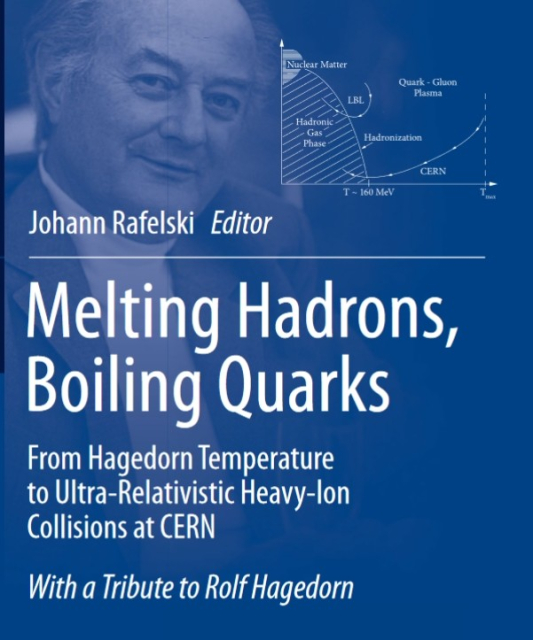
What would happen if you could take a piece of matter from a neutron star and keep heating it up under pressure? You can pump more and more energy into it - but according to Rolf Hagedorn's calculations back in 1964, its temperature will never go above 1.2 trillion kelvin! Past that point, all the energy goes into creating more and more new kinds of particles and antiparticles.
You see, the matter in a neutron stars is not just neutrons. It's also made of protons and other kinds of particles, called hadrons (not hardons). Only the lightest of these are common at low temperatures. But if you could heat the matter in a neutron star, so the neutrons start colliding with each other more energetically, there would get to be enough energy that more and more different kinds of massive particles get created in these collisions.
At least that was his theory. Now we know that all these particles are made of quarks and gluons, and when the temperature gets high enough these particles smack into each other so hard that they just *break*, creating a quark-gluon plasma.
But his idea of a maximum temperature was a good one. Whenever the number of energy levels of a system grows exponentially or faster with temperature, it will have a maximum temperature! And this is called the 'Hagedorn temperature'.
The simplest example is the 'primon gas', a theoretical gas where there's one kind of particle for each prime number, and the energy of the prime p is log(p). The partition function of this gas is the Riemann zeta function. 🤓 As you heat this gas, you approach the pole at z = 1, and you create a shitload of prime numbers.... in theory.
I'm writing about this stuff for my book on entropy.




































Esther Payne
in reply to s'Hackstub • • •Pietervdvn
in reply to Esther Payne • • •