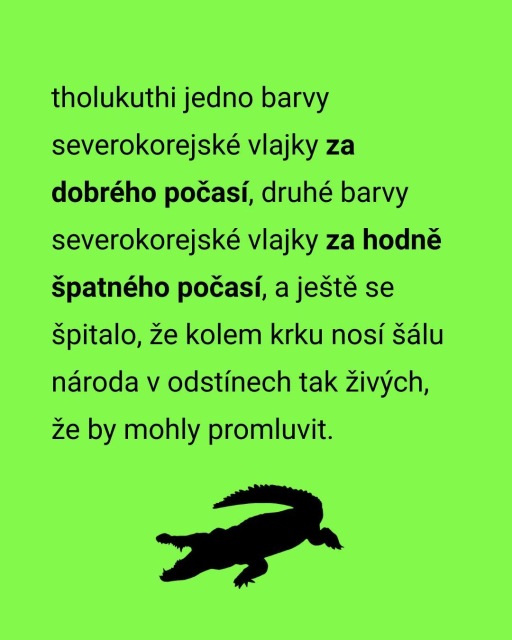
I forgot that I did eventually edit the first line of the book. It was originally, "I did not want to write this book."

Disabling Intelligences eBook is available now link.springer.com/book/10.1007…

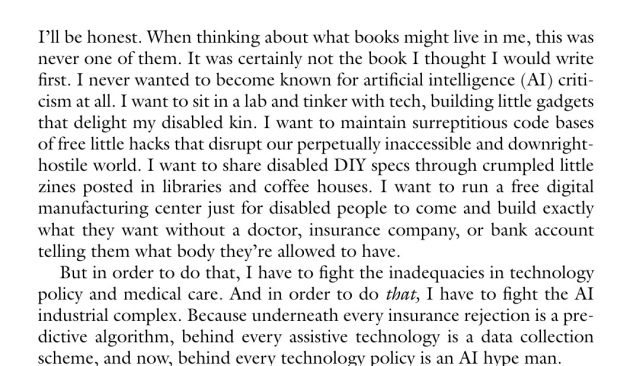
Image text : I’ll be honest. When thinking about what books might live in me, this was never one of them. It was certainly not the book I thought I would write first. I never wanted to become known for artificial intelligence (AI) criticism at all. I want to sit in a lab and tinker with tech, building little gadgets that delight my disabled kin. I want to maintain surreptitious code bases of free little hacks that disrupt our perpetually inaccessible and downright-hostile world. I want to share disabled DIY specs through crumpled little zines posted in libraries and coffee houses. I want to run a free digital manufacturing center just for disabled people to come and build exactly what they want without a doctor, insurance company, or bank account telling them what body they’re allowed to have.
But in order to do that, I have to fight the inadequacies in technology policy and medical care. And in order to do that, I have to fight the AI industrial complex. Because underneath every insurance rejection is a predictive algorithm, behind every assistive technology is a data collection scheme, and now, behind every technology policy is an AI hype man.

#AI #AIhype #Disability #eugenics #metaeugenics
Anyone using NetUpDown?

apt.izzysoft.de/packages/com.b…

The app wasn't updated since 2017, but we still see a lot of downloads for it (by F-Droid clients), so chances are folks here will still have tried it. Does it still work, so we shall keep it – or is it rather broken, so we'd better remove it from the #IzzyOnDroid repo?

EDIT: Confirmed twice now, for Android 15+16, so we'll keep it. Thanks!

#serviceToot #FollowerPower

This entry was edited (3 months ago)
in reply to Deus Figendi.jwd

@deusfigendi Yupp. But still, there's always the question of whether a newer Android version breaks things. And with our small team, we cannot test all the 1.3k+ apps continuously – as unfortunately our funding is not sufficient to cover even a part-time job, so we all have our $dayjobs to cover, and care for IzzyOnDroid in our spare time. Luckily, funding at least covers server costs, and thanks to NLnet we can cover some other long-due tasks…

🌹Dear friends,
I’m writing to you from Gaza, where life has become extremely difficult. I understand everyone has their own responsibilities and struggles, but if you are able to help—even in a small way—through this link, I would be deeply grateful.
Even simply sharing the link with others would mean so much to me and my family.
Thank you kindly, and may you always be safe and well 🌷

gofundme.com/f/fled-gaza-bombs…

#gaza #donate #palestine #genocide

Regarding my rant on those share.google links, they definitely are not there for your benefit. Every URL they make for you is unique, and you can be sure they use this for tracking. share.google/QORPsGkbhYKRBUhz1 and share.google/N9M35AUGzdVsPijVw both point at exactly the same page. And carry 100 bits of entropy. The redirect goes past www.google.com so they can hoover up your google cookies also...

reshared this

Here's something @MutedTrampet might find interesting. There's a program called Ptmid for MS-DOS to convert, with many restrictions, MIDI files to Mod files. A zip containing source code, docs, and DOS executable can be found at: archive.org/download/ptmid3_zi… and of course it doesn't want to compile under modern compilers or I'd make a Windows binary. Anyway I spent some time playing with it last night and one of the results is a strange conversion of a MIDI I made years ago that @BorrisInABox and @cordova5029 among others will no doubt appreciate. Here's a wav of it.

Leseempfehlung: mi-di.de/magazin/warum-der-kol…

Ich war diesen Sommer auf dem kollapscamp.de und arbeite seit dem daran, welchen Beitrag Kirche(n) in Kollaps und Krisensituation leisten können. Technisch als Standorte für solarbetriebene Notkommunikation z.B. über #MeshCore oder #Meshtastic aber auch sozial wer welche Räume und Ressourcen in welchen Szenarien zur Verfügung stellt.

Bei midi gibt es jetzt zwei Texte mit guten Impulsen dazu von Walter Lechner und Gabriela Hund

in reply to Timo Versemann

Das ist ja interessant!

Unter vielem anderen auch der Hinweis von @gabrielahund@hessen.social
Verlernen müssen wir auch die Selbstsicherheit, dass wir schon genau wissen, was andere brauchen, und dass wir selbstverständlich über die benötigten Fähigkeiten verfügen.
#Kollaps #Disruption #Klima #Seelsorge #Hoffnung #FediKirche

Anyone using #Tammy as a #Matrix messenger client?

What do you think about it? Why do you use it? How much do you use it? On which device type is it installed? What features do you miss?

  • Yes. (15%, 3 votes)
  • No, but already tried it. (5%, 1 vote)
  • No, but heard about it. (15%, 3 votes)
  • No, never heard about it. (65%, 13 votes)
20 voters. Poll end: 3 months ago

Peter Vágner reshared this.

in reply to Benedict

First of all: Thank you for your work!
I use it on Android alongside with other #Matrix Clients.
So far I remember, the onboarding was good. Generelly it feels fast (after) sync.
The chatlist items, for me, could have a little bit more padding. The gui with the bubble style in the Chats I don't like much.
It's nice to have some settings for gui. The accent color could have more options.

Dobrá práce @jakubzelenka 👍🏻
pagenotfound.cz/clanek/desitky…

We had to start charging the electric car from the grid this week due to bad weather and shorter days, but between this week and mid-April, when we got the car, we charged it exclusively from solar power. Six months and six thousand kilometers. Not bad.

#ElectricVehicle #electromobility #renewables #photovoltaic #renewableenergy

Peter Vágner reshared this.

in reply to Schmaker

@schmaker before getting an electric car we paid 2.5-3k CZK for gasoline per month. The average petrol consumption cost was 3 CZK/km for the petrol car. When I charge from the solar system I only count the cost of missed opportunity for not being able to sell the energy to the grid. It's 1.25 CZK/kWh and with the average EV consumption of 15 kWh/100 km the cost per km is 0.2 CZK. 15 times lower.

The XMPP Interop Testing project helps ensure XMPP servers and clients play nicely together by providing specification test automation.

New update:
✔️ Option to fail runs if some tests were "impossible" to execute.
✔️ Flexible account provisioning

Details on the blog: xmpp-interop-testing.github.io…

The development journey that @fishbowler and I have been taking was made possible by a grant from @nlnet 🙏. The grant has now concluded, and we’re deeply thankful for their support!

#XMPP #interop #testing

reshared this

Chat I think I've made it and become a Software-Visionary 🤔

For years it has been obvious to me that a snail-like arrangement of browser tabs would be superior to linear modes. It clearly guides the visual focus to the screen center, and you notice when your tabs spiral out of control.

After years of brainstorming a friend started building it: github.com/grubersjoe/tabsnail

Boeing settles lawsuit on wrongful death claim related to deceased whistleblower
https://www.ctvnews.ca/world/article/boeing-settles-lawsuit-on-wrongful-death-claim-related-to-deceased-whistleblower/?utm_source=flipboard&utm_medium=activitypub

Posted into Business @business-CTVNews

It turns out that you can already run GUI Linux programs in the new Linux terminal app on Android 16, before Google releases the official GUI support. First I switched the audio system to pipewire in the VM by installing the pipewire-audio package, then I installed xrdp (an RDP server for X11), and pipewire-modules-xrdp, for audio support. Then I installed mate-desktop-environment and orca, enabled accessibility in Mate with "gsettings set org.mate.interface accessibility true", and enabled Orca to start automatically with "gsettings set org.gnome.desktop.a11y.applications screen-reader-enabled true". Then I set the password for the default "droid" user with "sudo passwd droid", and created ~/.xinitrc with "#!/bin/sh" and "mate-session", and made it executable with "chmod +x ~/.xinitrc"" After doing all of this, I pressed the third unlabeled button in the Terminal app to open its menu, went to "Port control" and enabled port 3389. Then I installed Windows App from the Play Store and I added a PC with hostname 127.0.0.1, and added a user with the name "droid" and the password I set. When I connected to it, Orca started speaking, and after turning TalkBack off by holding the volume keys, I could control the Linux system with my Bluetooth keyboard, including using the Control and Alt keys, and after putting Orca in laptop mode (by running "orca -s" to open the preferences dialog), I could perform Orca commands with the caps lock key, although sometimes it types a letter instead and it toggles Android's caps lock state (which is separate from Linux's), but pressing caps lock once toggles it off again.

Peter Vágner reshared this.

libxml2's sole maintainer Nick Wellnhofer steps down, meaning libxml2 is now no longer maintained.

discourse.gnome.org/t/stepping…

It's hard to estimate just how many companies depend on this software and critical security updates to the library, so I'm certain many will quickly step up and offer sponsorship to ensure a fundamental dependency doesn't just deteriorate without proper support.

Any day now.

reshared this

Politique française, Israël, hamas

Sensitive content

Happy Petrov Day to those who celebrate. On September 26, 1983, Stanislav Petrov made the correct decision to not trust a computer.

The early warning system at command center Serpukhov-15, loudly alerting of a nuclear attack from the United States, was of course modern and up-to-date. Stanislav Petrov was in charge, working his second shift in place of a colleague who was ill.

Many officers facing the same situation would have called their superiors to alert them of the need for a counter-attack. Especially as fellow officers were shouting at him to retaliate quickly before it was too late. Petrov did not succumb.

I've attached a short clip from a reenactment of the situation in the documentary The Man Who Saved the World.

The computer was indeed wrong about the imminent attack and Petrov likely saved the world from nuclear disaster in those impossibly stressful minutes, by daring to wait for ground confirmation. For context one must also be aware that this was at a time when US-Soviet relations were extremely tense.

I've previously written about three lessons to take away from Petrov's actions:

1. Embrace multiple perspectives

The fact that it was not Stanislov Petrov's own choice to pursue an army career speaks to me of how important it is to welcome a broad range of experiences and perspectives. Petrov received an education as an engineer rather than a military man. He knew the unpredictability of machine behavior.

2. Look for multiple confirmation points

Stanislav Petrov understood what he was looking for. While he has admitted he could not be 100% sure the attack wasn't real, there were several factors he has mentioned that played into his decision:

- He had been told a US attack would be all-out. An attack with only 5 missiles did not make sense to him.
- Ground radar failed to pick up supporting evidence of an attack, even after minutes of waiting.
- The message passed too quickly through the 30 layers of verification he himself had devised.

On top of this: The launch detection system was new (and hence he did not fully trust it).

3. Reward exposure of faulty systems

If we keep praising our tools for their excellence and efficiency it's hard to later accept their defects. When shortcomings are found, this needs to be communicated just as clearly and widely as successes. Maintaining an illusion of perfect, neutral and flawless systems will keep people from questioning the systems when the systems need to be questioned.

We need to stop punishing when failure helps us understand something that can be improved.

reshared this