
Sensitive content
#XMPP Summit
@guusdk presented about "Open, federated chat in a regulated world".
The XMPP Summit:
xmpp.org/2025/11/xmpp-summit-2…
Meet us at #FOSDEM 2026, too!
#jabber #chat #opensource #messaging #federation #Brussels, #Belgium #rtc #e2ee

XMPP Summit 28 | XMPP - The universal messaging standard
The XMPP Standards Foundation (XSF) is exited to announce the 28th XMPP Summit taking place in Brussels, Belgium next year - just before FOSDEM 2026. The XSF invites everyone interested in development of the XMPP protocol to attend, and discuss all …xmpp.org
#xmpp
#opensource
#Jabber
#federation
#fosdem
#chat
#messaging
#belgium
#brussels
#rtc
#e2ee
@Guus der Kinderen
This entry was edited (4 hours ago)







































Hiisikoloart
in reply to 🆎 • • •David Chisnall (*Now with 50% more sarcasm!*)
in reply to Hiisikoloart • • •In theory, it’s people who care a lot about audio quality. They often claim to have better than average frequency range in their ears (many do, but a lot claim to hear things only bats can actually hear).
For a long time, a lot of consumer audio equipment was pretty terrible, so there were real reasons for wanting something better, I remember listening to a CD that I’d heard many times on my CD player and ripped to my iPad and discovering that CD player from the ‘80s had completely lost a load of low-volume bits and there was material that would probably have been audible on an expensive player in the ‘80s and was easily audible on a cheap player in the early 2000s.
At the same time, the Loudness War happened. Music execs found that people were more likely to like music if it was loud the first time they heard it. So they started making CDs louder. But CDs have a fixed dynamic range, so making it loader lost detail. They couldn’t do this with records because the needle would jump out of the track, so we had a weird period where LPs had better audio fidelity than CDs. Unfortunately, LPs are really finicky and it’s very easy to scratch them if you don’t perfectly balance the stylus to avoid more than minuscule pressure on the surface.
So, to listen to the highest-quality music, you needed a moderately expensive record deck, a decent amplifier (and pre-amp: again, LPs are annoying to play), and speakers. And it was fairly noticeable if you got any of these wrong.
But then DACs got a lot better. Cheap USB audio adaptors for computers had much better precision than anything available in the ‘80s, and could be placed outside of the case and away from RF interference from the computer. AAC audio supports a variable dynamic range (so bumping the loudness is just a scaling factor, not a loss of precision). Baseline speaker and amplifier quality improved a lot. By the mid 2000s, fairly cheap equipment gave better sound quality than anything you could buy in the ‘90s.
By then, an entire industry had grown up to cater to people who wanted the best sound quality possible and an even larger group of people who wanted to be seen as having the best sound quality. It moved from music appreciation to conspicuous consumption as a primary market driver. And that made it a ripe target for scams.
For analogue things, there were obvious things you could sell, like cables with gold-plated connectors. Gold is a good conductor and, unlike copper, doesn’t corrode, so this would make a difference (whether the difference is audible is another matter). But the move to mostly digital paths made this harder. You got very silly things like ‘audiophile grade’ Ethernet cables and optical connectors, which ignored the fact that the digital protocols had built-in error correction and that audio is staggeringly low bandwidth in comparison to other things carried over these connections so there’s space for a lot of error correction. A load of these things can be run over a wire coathanger with no loss in quality.
The entire ecosystem became dominated by very silly things. But they’re all quite interesting because they have some plausible-looking science behind them, which then goes off in a nonsense direction. For example, Ethernet is an electrical protocol, so signal quality matters. Gold is a good conductor. Gold connectors on Ethernet cables will reduce signal degradation. Pay no attention to the fact that the Ethernet standard is specified based on specifically rated cables and won’t be any better on ones with marginally better connectors.
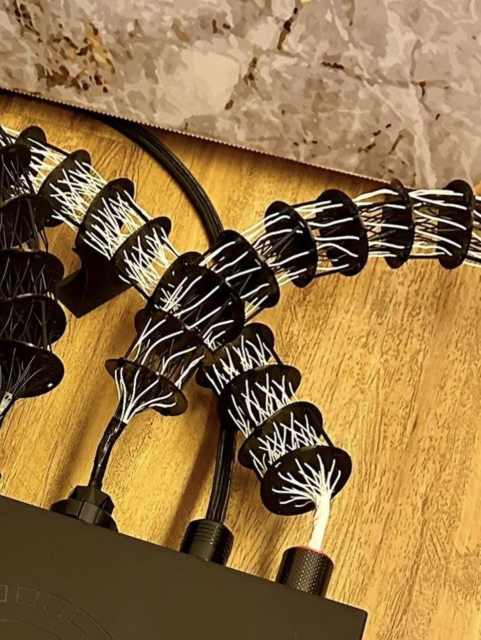
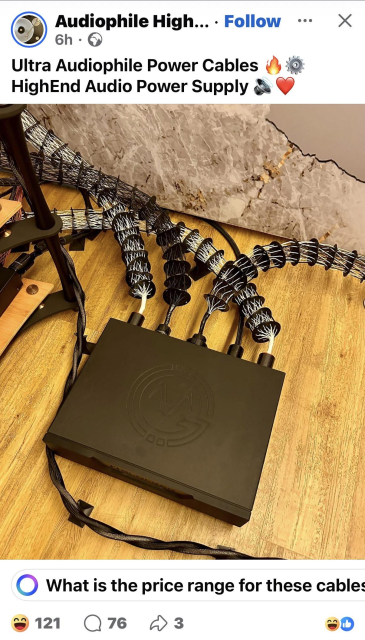
My guess from the picture is that someone has noticed that electrical noise from a power supply can be a problem and has built something that looks very plausibly like it would solve that.