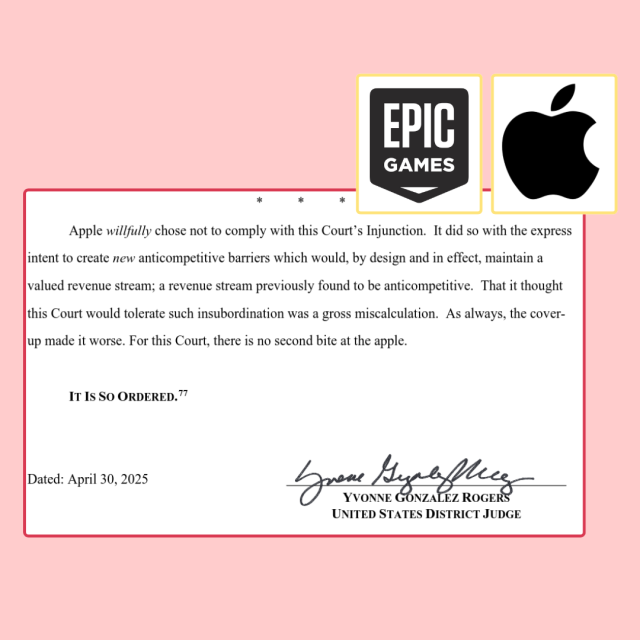
🚨BREAKING: #Fortnite is coming to US App Store any day now!

US judge said #Apple “outright lied” to steal from app developers & increase prices for users - all to uphold its greedy #monopoly.

But the days for FEES on web transactions are finally gone.

Fortnite was submitted to the US App Store yesterday - so it now lies with Apple to publish it quickly: x.com/TutaPrivacy/status/19212…

Read the whole story: 👉 tuta.com/blog/apple-us-antitru…

This entry was edited (7 months ago)

I’m currently taking a long break from making music, art, and new :MW: MOULE WORLD lore, but you can listen to my back-catalogue of all 136 of my multi-genre electronic releases on:

Faircamp: music.moule.world
Bandcamp: moule.bandcamp.com

I think I’ve finally tired out my inner perfectionist demanding I stick to a fortnightly release schedule, causing me lots of burnout. Now the challenge is getting back to making new stuff again! :MOULE_Ha:

#Music #EDM #ElectronicMusic #MouleWorld

What does it mean to think on the scale of centuries? Great discussions with Stephen Heintz & Kim Stanley Robinson.

The Long Now Foundation offers a fascinating read on long-term logic, design, and the ethics of building for the future.

longnow.org/ideas/a-logic-for-…

#LongNow #FutureThinking #SystemDesign #Podcast

How do government software systems break—and how can we fix them?

Mikey Dickerson (healthcare.gov rescue, USDS) talks with @patio11 about procurement, crisis engineering, and why modernization plans often make things worse before they get better.

A great listen for anyone in civic tech or public service.

complexsystemspodcast.com/epis…

#govtech #complexsystems

Automated #accessibility test tools find even less than expected (by Robert Dodd via LinkedIn) linkedin.com/pulse/automated-a… #a11y #testing #tools

Tiny new feature: Checkboxes in a message.

No, I'm not gonna make it a full blown task list app 😜 but it happens quite often, that my wife sends me a list of groceries when I'm walking to the supermarket. This way I'm now able to check, what I have already in my cart so I don't forget anything.

It works by sending special reactions under the hood. So anyone with reaction sending permissions in a room can check any box from any sender.

What do you think?

#matrix #fluffychat @matrix

in reply to chebra

WhatsApp and other closed source apps have a full dictatorship over the whole protocol and all clients. They can experiment with new features on all users at once, and they can turn them off if they don't meet the expectations for all at once.

How exactly do you want to do this in open world? Some clients will inevitably lag behind, some clients will not implement all features. Even if you didn't allow other clients to experiment with API proposals, they would lag behind the upstream.

The only thing you can do is to give developers tools to create reasonable fallback.

in reply to Shine

@shine It's not that hard. You just have to open your mind. Instead of invisible reactions this could be sending normal text messages `*Adam checked [x] option one` and supporting clients would render it as a checked checkbox, but unsupporting clients would at least have a meaningful fallback. The problem here is that Krille totally forgot to think about the unsupporting clients. And that's how we lose people.

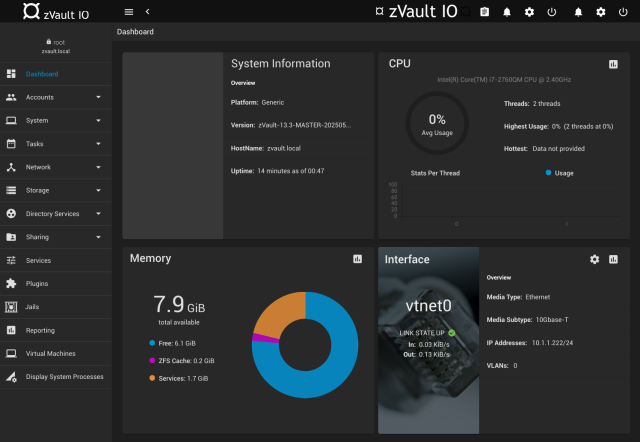
Added 𝗨𝗣𝗗𝗔𝗧𝗘 𝟮 - 𝗧𝗿𝘂𝗲𝗡𝗔𝗦 𝗖𝗢𝗥𝗘 𝗶𝘀 𝗗𝗲𝗮𝗱 - 𝗟𝗼𝗻𝗴 𝗟𝗶𝘃𝗲 𝘇𝗩𝗮𝘂𝗹𝘁 to the 𝗧𝗿𝘂𝗲𝗡𝗔𝗦 𝗖𝗢𝗥𝗘 𝘃𝗲𝗿𝘀𝘂𝘀 𝗧𝗿𝘂𝗲𝗡𝗔𝗦 𝗦𝗖𝗔𝗟𝗘 article.

vermaden.wordpress.com/2024/04…

#truenas #zvault #freebsd #zfs #storage #nas #core

in reply to Matt Campbell

@matt

It doesn't even work with the Mastodon WWW user interface, ironically.

The glyphs aren't in the Roboto WWW font requested by #Mastodon so WWW browsers fall back to whatever font is set locally.

Not only does that in itself make posts look like bad movie ransom notes, but it gets worse: because some fonts intentionally try to make the mathematical symbols distinct from truly boldfaced/italic Latin-1 alphabetic characters.

#Unicode #accessibility

Hey all I'm leading a session GAAD at AccessU. The session is free and open to the public and streamed on YouTube. I'm looking for questions about the shifting landscape of digital access and accessibility. This wide open and can be interpreted in many ways, but the hope is to get some questions that cover multiple perspectives.

You can submit questions here: forms.gle/2D9uvxfMSjC7p2pK7

Global Accessibility Awareness Day at AccessU
knowbility.org/programs/john-s…

Looking for something to do this weekend? Join the Month of #LibreOffice! Learn new things and expand your skillset – and get cool merch as a bonus: blog.documentfoundation.org/bl…

Your password manager is under attack, and this new threat makes it worse: How to defend yourself zdnet.com/article/your-passwor…

This has saved me a bunch of times, so might be useful to other people. When I change firewall rules on a remote machine, I always run the following command:
# service pf restart && sleep 30 && service pf stop<br>

And then I hit control-C after a few seconds. If my ssh session is still working, this cancels the service pf stop command. If I've managed to break my ssh connection with the rule change, the firewall is disabled after 30 seconds and I can revert the changes and reenable it.

reshared this

Monopoly wasn't invented by the Parker Brothers, nor the man they gave it credit for. In 1904, Monopoly was originally called The Landlord's Game, and was invented by a radical woman. Elizabeth Magie's original game had not one, but two sets of rules to choose from.
One was called "Prosperity", where every player won money anytime another gained a property. And the game was won by everyone playing only when the person with the least doubled their resources. A game of collaboration and social good.
The second set of rules was called "Monopoly", where players succeeded by taking properties and rent from those with less luck rolling the dice. The winner was the person who used their power to eliminate everyone else.
Magie's mission was to teach us how different we feel when playing Prosperity vs Monopoly, hoping that it would one day change national policies.
When the Parker Bros adopted the game, they erased the "Prosperity" rules and celebrated "Monopoly".

Hubert Figuière reshared this.

To all #OpenSource and #Linux warriors, to all saying "Ditch windows, install Linux", to everyone and every single person: please, spend several minutes and read this. I want you all to read this so you really understand the problem (if you want to understand, of course). And a huge, huge thanks to Aaron @fireborn for starting this post series. fireborn.mataroa.blog/blog/i-w… #Accessibility

Re: my last boost of @fireborn's post on Linux accessibility (fireborn.mataroa.blog/blog/i-w…), I propose that fixing audio on Linux would be a good place to start. "Linux audio doesn't work" is a meme even among sighted people. I know that reducing it down to that is perhaps unfair to all of the people who work on the audio stack, but there seems to be some truth to it. Any ideas on what can be done to finally make audio output as reliable as the graphics stack? I'll put money where my mouth is.
Unknown parent

mastodon - Link to source

Adrian Vovk

TTYs are very weird environments that exist outside of any kind of session, at least until you log in. They might as well not exist as far as most services can tell. This is just a legacy of how they work

The good news is that this all will be fixed sooner rather than later, because the TTY is going away. Instead it'll be replaced with a graphical terminal, which should give you access to a screen reader

Can't say much about the other issues. I've never run into them

in reply to Adrian Vovk

Some of your Pipewire issues might actually be Wireplumber issues. Pipewire is just dumb media routing. The smarts, like card and output selection, belong to Wireplumber. Are you using Wireplumber?

Are the bugs you've run into known issues, or have you filed bug reports? Realistically it's possible that you're triggering bugs that others haven't encountered and so they will never be fixed because nobody knows about them

The state of Linux accessibility in 2025. This started out as a rant but became a series. Please feel free to leave feedback, comments, and subscribe via rss or email for more stuff as I release it. fireborn.mataroa.blog/blog/i-w…

Secure by design in Python: A FastAPI app with 5 DevSecOps tools and a real time SSTI vulnerability remediation
#python #devsecops #security #webdev
dev.to/trottomv/secure-by-desi…
This entry was edited (7 months ago)

Weekend reading: Apple is celebrating 20 years of Voiceover - I wrote an article about it based on the amazing chat I had with the man who brought it to life on the Mac, and also with people who use it on their iPhone every day. doubletaponair.com/20-years-of…

The #Linux #kernel's #PGP Web of Trust

blog.kleine-koenig.org/ukl/the… (by @ukleinek )

"[…] However there is a problem on the horizon: GnuPG 2.4.x started to reject third-party key signatures using the SHA-1 hash algorithm. […] This doesn't directly affect the kernel-pgpkeys repo, […] When Konstantin imported the updated certificate GnuPG's "cleaning" was applied which dropped all SHA-1 signatures. So Theodore Ts'o's key lost 168 signatures, among them one by Linus Torvalds on his primary UID. […] That made me wonder what would be the effect on the web of trust if all SHA-1 signatures were dropped. Here are the facts: […]"