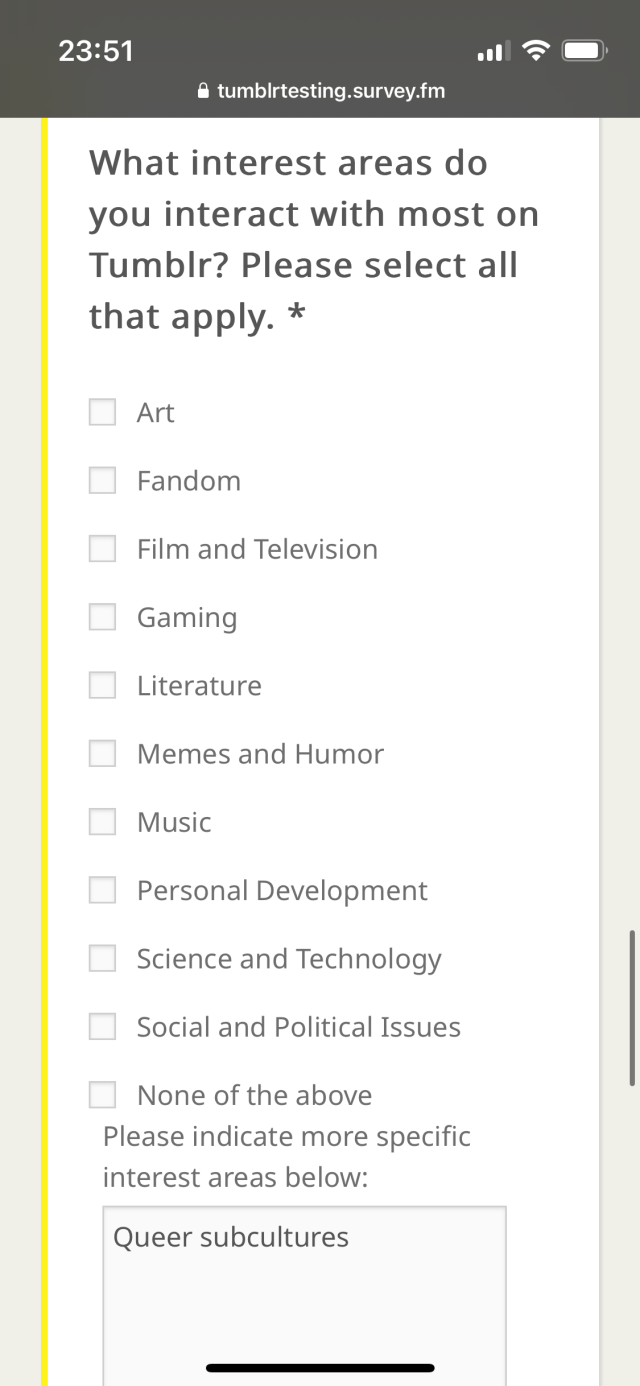
Knowing how the sausage is made at the company that owns Tumblr and how it announced a VIP contract with Chick-fil-A on Trans Day of Remembrance — I am absolutely not shocked at all.
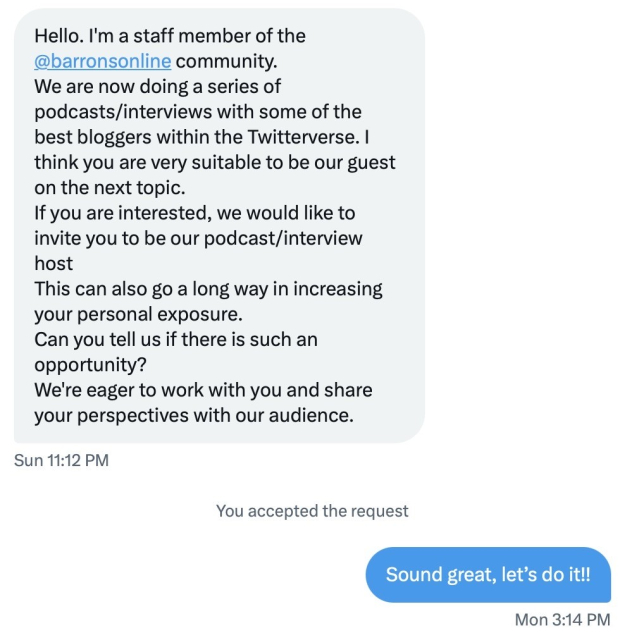
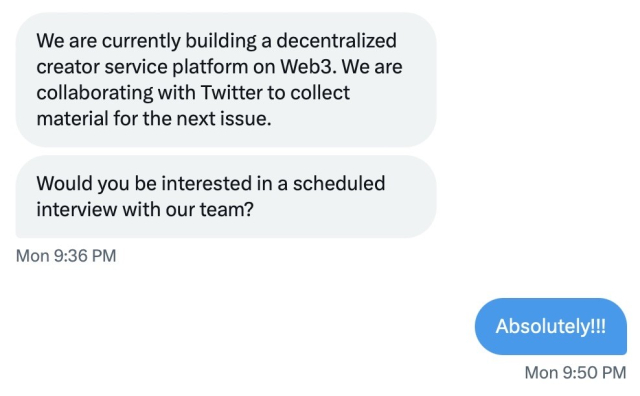
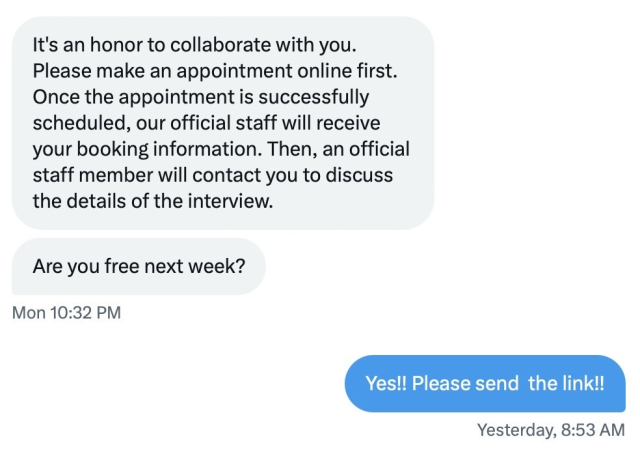
🎣① Here’s a story about an interesting DM phishing attempt I got over on Twitter.
It started with a DM from, uhh, ostensibly a staff member of Barrons (?), inviting me to a podcast (?) to do an interview about decentralized web3 creator service platform (?)
I wanted to see where it went, so, I was very enthusiastic
Ryan is one of my favorite persons in the #PHP community. I cannot imagine what he and his family must be going through. They face expensive medical bills and more ahead. If you can help financially, please do so.
Hi friends!
I have some bad news. On March 11th I went to the emergency room after … Ryan Weaver needs your support for Support Ryan's Brain Cancer Battle
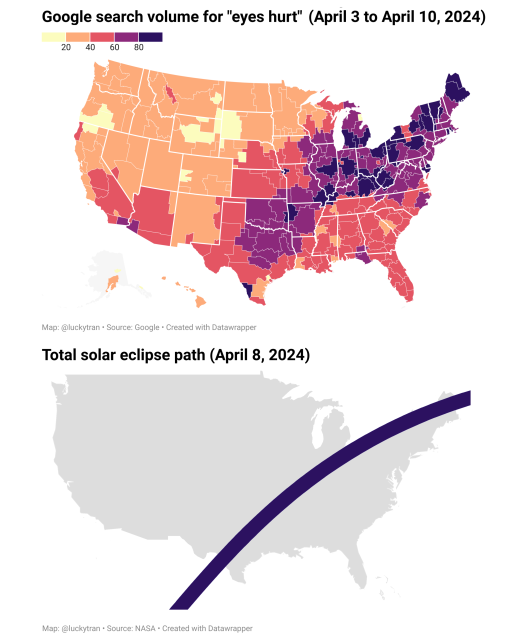
Even with all the eclipse photos circulating right now, this one made my eyes pop. Great shot of jet contrails breaking up the edge of the eclipsed Sun. Quick calculation: The Sun is about 30,000,000 times wider than the jet.
We are part of the #ZOOOMProject consortium, a #HorizonEU project with the purpose of promoting open technologies. 🚀
💡 Recently, the #FSFE legal team produced 4 chapters in 2 comprehensive reports, dealing with many topics, and providing empirical data on #FreeSoftware topics in 🇪🇺 in relation to critical technologies, such as AI.
Being unexpectedly out of work is a mixed bag for me — no surprise, I have a lot of projects that could use the attention. But it's also a tough job market, especially for a neuroatypical person at the staff+ level.
If you want to help —
Schedule a time to chat: calendly.com/aeschright/30min Even if your company isn't hiring at the moment, I'd like to hear what you've been up to. Particularly if you're in DevOps, dev tools, or something else in that vein.
Support my projects (pick whichever appeals to you most 🥰)
Writing: News Not Doom: patreon.com/news_not_doom Weekly-ish updates on themes in the news I think are worth digging into. Ships may feature prominently for a bit. It's not the only writing I'm working on, but this is where you'll see the most frequent updates.
Code: Sponsor me on GitHub: github.com/aeschright In addition to open source work, I started a new secret project that I think people will be interested in. It's going to take a few months to get off the ground, so this is where your support makes the most difference for me right now. ✨ Sponsorship is now available ✨
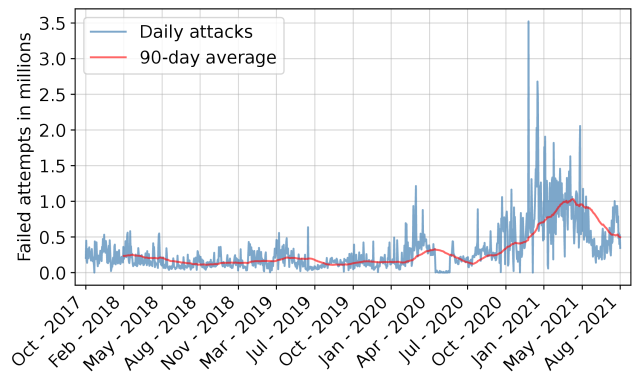
If you've ever looked at SSH server logs you know what I'm about to say: Any SSH server connected to the public Internet is getting bombarded by constant attempts to log in. Not just a few of them. A *lot* of them. Sometimes even dozens per second. And this problem is not going away; it is, in fact, getting worse. And attackers' behavior is changing.
The graph attached to this post shows the number of attempted SSH logins per day to one of @cloudlab s clusters over a four-year period. It peaks at about 3.4 million login attempts per day.
This is part of a study we did on our production system, using logs of more than 640 million login attempts, covering more than 1,500 hosts on our side and observing more than 840 thousand incoming IP addresses.
A paper presenting our analysis and a new, highly effective means to block SSH brute force attacks ("Where The Wild Things Are: Brute-Force SSH Attacks In The Wild And How To Stop Them") will be presented next week at #NSDI24 by @sachindhke . The full paper is at flux.utah.edu/paper/singh-nsdi…
I've got a big picture question that may sound silly: What's the point in blocking the attacks?
If you've got user accounts with weak passwords, then that is a problem that should probably be addressed with higher priority than the frequency of attacks.
If you've only got users with strong public keys, then attacks won't succeed anyway. Blocking them will save you some resources, but will also redirect the attackers to weaker targets. Isn't it overall better to just tank the attacks?
@samgai Not a silly question at all, it's a great question!
One reason to block ssh brute force attempts is that you may have devices on your network that you don't know are vulnerable: for example, we see lots of attempts to attack IoT devices, such as a big spike of attempts to log in to accounts associated with the Dauha backdoors when those were revealed. We also see lots fo attempts to log into routers from various vendors (Unifi, MikroTik, and Huawei).
Another is that in some cases, you don't have full control over your users. The facility we operate is cloud-like in the sense that we do control the initial configurations of sshd and can force users to use good passwords, but after that, they have root and can - and do - change configurations or set local passwords in a way that makes the vulnerable.
A third reason is that a lot of these attacks are *probably* coming from botnets that are launching a range of different kinds of attacks. So if you can easily recognize them as ssh attackers, you can block them completely, possibly saving yourself from other attacks.
Finally, they consume resources on the target machine - maybe not a lot, but heavy attacks can have a significant impact, and we want to keep this impact low.
I set myself the task to design and print 50 birds using a custom LEGO letterpress technique. This was in 2018. Figured it would take a year or so. I finished the last print earlier this year
Presenting the complete series for the first time in an exhibiton in the workplace where the prints were made. Opening this weekend:
Offenbar an Innenministerin Nancy Faeser vorbei hat sich die Ampel auf die Einführung des Quick-Freeze-Verfahrens geeinigt, das als Alternative zur Vorratsdatenspeicherung gilt.
We're often asked "When can I use Thunderbird in my browser?" It's a logical question! After all, Thunderbird was built on top of Firefox technologies, right?
Thunderbird was built on top of Firefox browser technology, right? So could there ever be a webmail view of Thunderbird? We hear this question a lot, so let's talk about it! 🔗 NEED SUPPORT? Thunderbird Community Support: https://mzla.
The monocles chat. A more modern and secure chat client for Android based on Conversations with features from blabber.im and Cheogram and a lot of own changes and improvements.
Sonos will release a redesigned mobile app on May 7th. The new software features a customizable homescreen, faster search, and easier setup for the company’s devices.
Re last about the sonos app redesign: They're ditching the tab bar in favor of multiple scrolling carousels... I already hate the sound of that, I've never seen one that wasn't a nightmare with screen readers. IE Revolut also uses a setup with endlessly scrolling tiles and I can never find anything in it.
#YunoHost devs are testing #Prosody as #xmpp #jabber replacement for metronome to get better integration with the system and better compliance with jabber standards. Also new default features as A/V calls.
1. Microsoft lost a general login key to its entire email system which enabled China to siphon off ~60,000 emails from the US State Department, the US ambassador to China, and other US government officials.
5. One engineer from a firm acquired by Microsoft in 2020 was working on a compromised laptop and in 2021 accessed the corporate network from that machine. It's not certain that this laptop was the root cause, but Microsoft published an update in March 2024 which stated a “compromised engineering account” is the “leading hypothesis” for the cause of the breach.
6. Instead of letting this compromise go unnoticed, Microsoft should have run a proper security assessment of the firm's network after its acquisition - which it didn't.
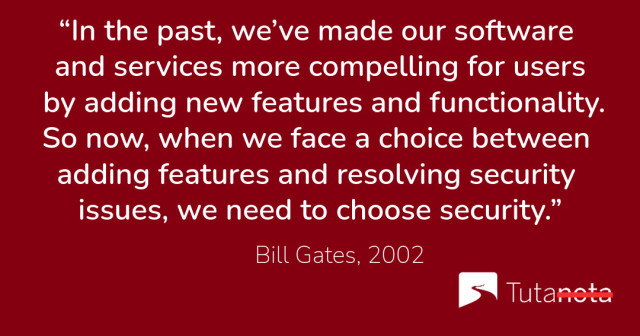
China's Microsoft hack shows why security must always be prioritized over features and why there must not be a general key that can be used as a "backdoor".
Apparently Meta is planning to release two small varients of Llama-3 next week "as a precursor to the launch of the biggest version of Llama 3, expected this summer." Command-r-plus, mixtral 8x22b, Google CodeGemma... All of sudden companies are releasing LLMS like crazy! Where's Apple? Maybe In WWDC 2024? lol #LLM #AI #MLtheinformation.com/articles/me…
Last year, the @sovtechfund fund invited us, the Sequoia PGP Project, to join their new Bug Resilience Program.
Today, I'm pleased to announce that we are publicly launching our bug bounty program with rewards of up to €10,000 for novel, security-relevant issues in Sequoia applications, libraries, or specifications. #pgp
tip for STF: the IBB bug-bounty (which #curl is part of) gives 20% of the bounty to the project and 80% to the reporter - which I think is nice because there is certainly work to be done from the project's part as well to deal with the issues ...
@bagder Thank you for the tip Daniel! For the BRP bug bounty, we offer projects an equal "fixing" bounty for reach responsibly reported and fixed vulnerability for that very reason. @sequoiapgp @sovtechfund
Meta introduced its ‘pay-or-okay’ model to respond to heightened requirements as to the way it collects users’ personal data for targeted advertisement. This mo
Pepo, zasad tresen Az odsunou nas Zbyde tu po nas Aspon ta tresen
To byla chvilka sudetske poezie s vuni medvediho cesneku a tresni. Jako je to hodne vysoko a 7. dubna. Pro rozkvetlou tresen 1. kvetna polezeme tak mozna na Snezku.
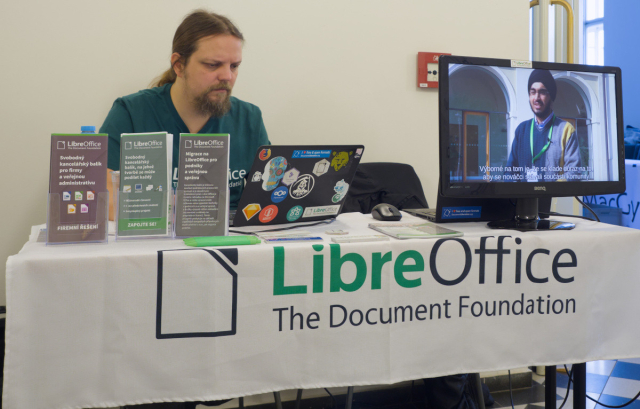
Our Czech community reports back from a recent event… For the third time, the LibreOffice project had its own booth at InstallFest 2024, and here we present our experiences from the event.
Our new Chief Technology Officer, Gerald Hartig, is being interviewed on Vision Australia Radio tonight at 8:10pm AEST (About 1hr 15mins after I post this). You can tune in online at: player.listenlive.co/65731/
Accessible news, information and entertainment.
Vision Australia Radio offers a range of interesting and informative programs that feature readings from the latest newspapers, magazines and books.
@CodingThunder it would be utterly naive of me to assume that it would A) show the correct country always and B) that just because they login from a specific country they live there or are residents of that country...


































Blippy the Wonder Slug 🇩🇪
in reply to Dr Zoyander Street • • •